I recently traveled to the beautiful state of Oregon for a family vacation. It was my first visit to Oregon and home state of the world headquarters of Nike. I did inquire with my Uber driver about the possibility of doing a tour of the Nike campus but it was closed for the weekend.
However, my parents and I visited the Portland Japanese Garden which was a great reminder of the art of practicing mindfulness and meditation. The stones, waterfalls and fauna all created a sense of calm that Jon Kabat Zinn once spoke about during a lecture I attended in Boston’s Arlington Street Church.
Visit to Portland Japanese Garden Photo Credit: T.Mohammed
Mindfulness and meditation are methods of coaching that are very much in the news and being written about by academics, medical professionals and sport researchers. Amy Baltzell recently published a book with several authors on Mindfulness and Performance and Sam Parfitt leads the True Athlete Project which both reinforce the sporting applications for mindfulness and meditation. The science behind meditation and mindfulness is helping with the evolution of sport for development and peace as a form of daily practice to aspire towards.
Earlier in the year, I traveled almost 24 hours door to door from Andover, Massachusetts to Peermade, Kerala, India to see my maternal grandparents who were not keeping good health and (and have since March 2016 stabilized their health in old age and God-willing will continue to do so). As mentioned in an earlier blog post, it was an opportunity to spend time with family members and reconnect with positive childhood memories.
Near the Main Gate at Kodaikanal International School visit in 2016. Photo Credit: M. John
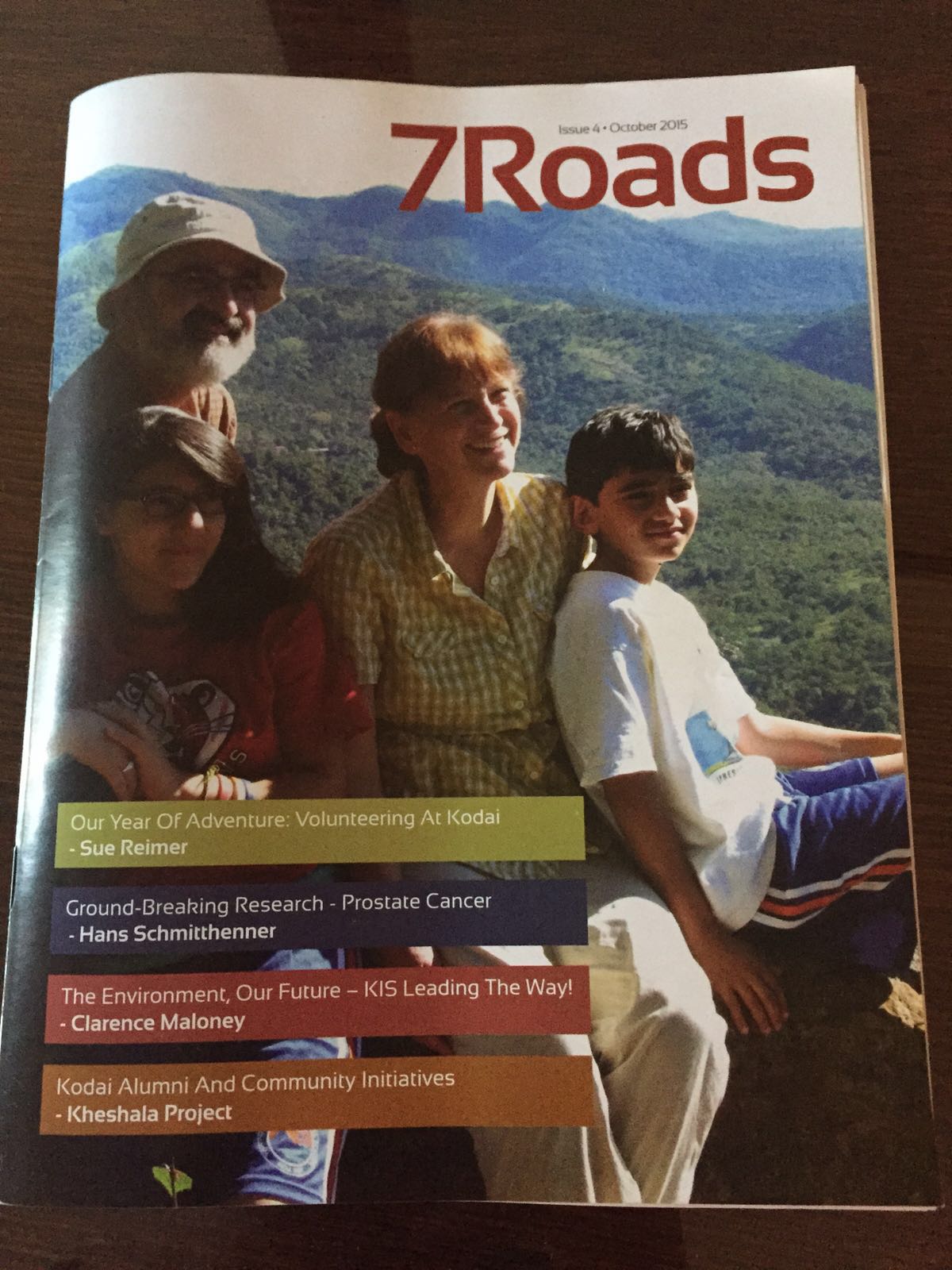
My Keralite cousins organized a trip to visit Kodaikanal International School, one of two international schools I attended as a boy. Thanks to Yvonne Dovlo, Alumni Officer and KIS alumni who work to support Khelshala, a registered charity in Chandigarh, India – we were featured in 7 Roads: The Kodai Alumni Magazine – something I never imagined would happen when I was student more than 20 years ago.
Cover of Kodai Alumni Magazine referencing Khelshala Project.
During my visit to KIS it was great to reconnect with staff, teachers and alumni who I had shared time with when I was a student there. These sorts of visits are “good for the soul” as my uncle – Tawheed Hazarika, likes to remind me. My cousins and I were lucky to get a personal tour of the school and eat lunch in the dining hall thanks to one of the new teachers.
Attending Sunday Service at Margaret Eddy Memorial Chapel at Kodaikanal International School in 2016. Photo credit: M. John
KIS prides itself on multiculturalism and tolerance of all faiths and backgrounds which is expressed in the school’s motto of “unity in diversity.” On the whole, I was delighted to see the campus so well maintained with many improvements too. It was also great to briefly meet Corey Stixrud, Principal of KIS and to know that the school is continually striving for and meeting the educational needs of the next generation of Indian and international students.
I’ve been spending a lot of the time in Memorial Hall Library in Andover, MA contemplating, transitioning and hopefully preparing for the next step(s) for what the future may hold. Libraries are interesting spaces for self-discovery if one is at a crossroads.
Ruben Sanca, a Cape Verdean Olympian distance runner gave a talk at Memorial Hall Library to a diverse audience of New England residents. He spoke about his London 2012 Olympics experience and other highlights from his running career as well as his training regime while working full-time at University of Massachusetts Lowell. He generously answered questions from the audience ranging from running shoes, injuries and recovery.
Ruben Sanca, a Cape Verdean Olympian speaking at Memorial Hall Library.
It was reassuring to hear Ruben give advice to parents of young athletes on how every athlete is different and the importance of having fun. His positive developmental message to the audience was to enable young athletes to develop an interest in sport through an organic process. As a qualified coach, I was pleased with Ruben’s view that parents should enable young athletes to continue if they derive enjoyment from their participation.
Overall, it was an educational experience to attend the Memorial Hall Library event and meet an Olympian who is waiting to find out if his wild-card entry to the 2016 Olympics in Rio will be granted. Thank you to the staff and volunteers at Memorial Hall Library for organizing programs and events of interest.
My attempts at blogging have taken many forms with its origins in East Africa and then transformation in the prep schools of New England all tied together with the thread of sport.
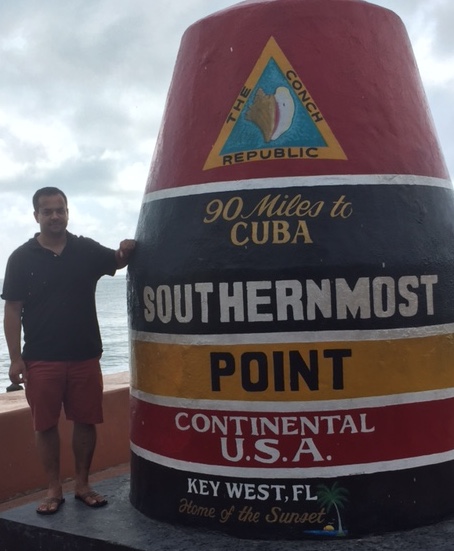
In the spirit of the game of squash, I have chosen to mix up the last point by sharing with you my vacation photo from October 2015. This by no means is a political or social commentary but rather a bit of fun. My previous blog post was a little preachy as it was intended for a younger audience, but the photo below hopefully lets it lighten the mood.
Thank you and God Bless America!
Once again, thank you for being part of this journey with me across the globe. In the meantime, I will take a break to search for things to explore and write about in some shape or form. Until then, I encourage you to comment or communicate with me on productive thoughts and/or suggestions. Thanks for reading!
As you are probably aware this blog is outdated and no longer being updated. I didn’t want to stop without being able to reflect with you upon three lessons gained from life experiences, which I believe can be one of our greatest teachers. My hope is that it will help you think about your own life.
The first lesson was learned while I was a high school student in the United Arab Emirates. This was among the several countries my siblings and I grew up.
After a long day at school, I decided to go for a run to take my mind off homework. At the time, Laylah, my youngest sister was the only person home. I asked her to let my parents know that I had gone for a run and that I would be back home in time for dinner. Little did I know I would not make it home for dinner that evening.
I set forth on my usual route with Walkman in hand. (For those of you too young to remember what a Walkman is, it is one of the early precursors to the iPod). My memory of what happened next is unclear. All I remember is waking up in a hospital emergency room and my entire upper body soaked in blood with my mother at my bedside. I have no recollection of how I ended up there.
From police reports it appeared that while running, I was knocked down and unconscious by a car. Except for the shattered glass that had scared my face and back, there were, fortunately, no serious injuries. No broken bones. No lost limbs. Nonetheless, doctors told me that I had experienced a severe shock to the body and mind (deemed a concussion) and that I would need to miss the remainder of my 11th grade.
On one hand I was relieved, that I wouldn’t have to take final exams, but on the other hand disappointed that I had to stay home and could not spend time with fellow classmates. During the recovery, I had time to reflect upon the seriousness of what had happened and came to the conclusion I had a near death experience.
At first this troubled me, but as I thought more deeply I came to understand that I had been given a second chance to live. I felt fortunate to be blessed with a miracle. While not everyone believes in God, I do believe there is a force greater than humanity.
Some call this force God. Some call it Jesus. Some call it Allah. I’m not a very religious person, but I could not help think about this force. It kept me alive and is why I am here today. Thus the first lesson, I would like to share with you is that, I believe, we are each here to serve a purpose.
My second lesson stems from an international childhood and brief career in international affairs. I am an American citizen of Indian heritage but was born in the United Arab Emirates and educated in the United Kingdom, Saudi Arabia, India and the United States. My multicultural upbringing might appear unique, but there are a growing number of Americans and international students, who also hail from diverse backgrounds and venture to and from foreign lands.
During 2003-2004 I served as a United Nations Volunteer under Kofi Annan, former Secretary General’s initiative called United Nations Information Technology Service (UNITeS) in Kampala, Uganda to promote volunteerism as well as foster peace and sustainable development. Based at Makerere University, a leading institution of higher education in East Africa, I was living in a country with a history of Indophobia.
In the early 1970s, Idi Amin, a former President of Uganda expelled thousands of Indian immigrants due to fear of economic insecurity for ethnic Ugandans. Fast-forward to present day Uganda, Indians are gradually returning to Uganda – mostly in small numbers – to reclaim their properties.
Given the historical plight of Indians in Uganda I was anxious as to how I would be received by my Ugandan counterparts. Would they see me as another Indian threatening their livelihood? Would I be considered a naïve, twenty something Indian-American aid worker imposing Western values? Would they just accept me for my ideas, thoughts and actions while being a guest in their country?
My mission in Uganda was to strengthen and expand the Cisco Networking Academy Program, a global online curriculum for schools and universities across the country. The Cisco program prepares students and working professionals to design, build and maintain computer networks.
I am not an expert in networking computers, but did have prior work experience publishing research on the intersection of business, technology and policy under the direction of Jeffrey Sachs, a highly acclaimed economist, at the Center for International Development at Harvard’s Kennedy School of Government.
Fortunately with hard work, openness and a willingness to learn about Ugandan culture I was able to build trust among Ugandan colleagues. Living in a foreign country, far away from family and close friends, I learned how to make new friends and appreciate how human bonds tie us together. This is what truly enriches our lives.
At Concord Academy everyone is valued for their individuality and at the same time their is a respect of common beliefs. Hence, the second lesson I would like to share with you is that while everyone is unique in their own way, we must not forget to celebrate our common values in this increasingly complex world.
My third lesson is a culmination from my lifelong passion for squash – the sport, not the vegetable (Although after living in New England, I have also grown to like squash soup!). I became acquainted with the sport when my mother would go for her squash lessons.
Curious to know how this racquet sport was played, I eventually made my way on to a squash court by the age of 12. Living in Saudi Arabia it was also a way to beat the heat and exercise in an air-conditioned room.
Looking back, squash has opened many doors for me. During my college admissions process Dan Hammond, an All-American squash player at West Point and Head Squash Coach at Bowdoin College, a highly selective liberal arts college in Maine, actively recruited me as a student-athlete. I would not have gained admission based solely on my academics. Squash opened the door.
Also, my first paycheck in the United States was thanks to squash. During the summer of my freshmen year in college, I worked as a counselor at the Harvard Junior Squash Camp under the direction Bill Doyle, a former Head Squash Coach at Harvard. Squash opened the door.
During my junior year of college I was invited to attend an alumni function with key donors and was seated, by the organizers, at a table with Robert Edwards, a former President of Bowdoin College and his wife, along with several accomplished alumni.
Puzzled at first, I came to understand that I was selected to be seated at that particular table, not because of my academic prowess, but because I happened to be co-captain of the varsity squash team under the direction of Satinder Bajwa, a world renowned squash coach who was subsequently the Head Squash Coach at Bowdoin College during my senior year. Looking back, meeting Baj (as he is known in the squash world), was a tremendous, positive life-changing experience.
Squash has continued to provide many opportunities even after college. For instance I got my first desk job at Harvard, because Geoffrey Kirkman, Managing Director of the Information Technologies Group at the Center for International Development liked the fact that I was a squash player and coach who showed promise beyond academics.
Again, if it were not for my interest in squash, I would not have been able to coach at various New England colleges, universities and prep schools. Neither would I have had the opportunity to help implement the 2006 Super Series Squash Finals, featuring the world’s top 8 players in London, England.
Neither would I have received a travel grant to visit a poor village in India to conduct coaching clinics for underprivileged children. I could go on.
I am very grateful and honored for being involved with Khelshala, a non-governmental organization, that allows me to play a part in helping other students can gain education and career opportunities through sport. Thus the third, lesson I would like to share with you is that don’t underestimate the value of your extra-curricular activities.
In short, my three lessons for you are: (i) live a purposeful life because you never know when it may end (ii) embrace all the diversity the world has to offer and remain inclusive and (iii) last, but not least, don’t forget to nurture your talents. It sounds simple to say, but, at times, it can be difficult to put into practice.
My name is Tariq Mohammed, which among other things, in Arabic means “he who knocks at the door.”
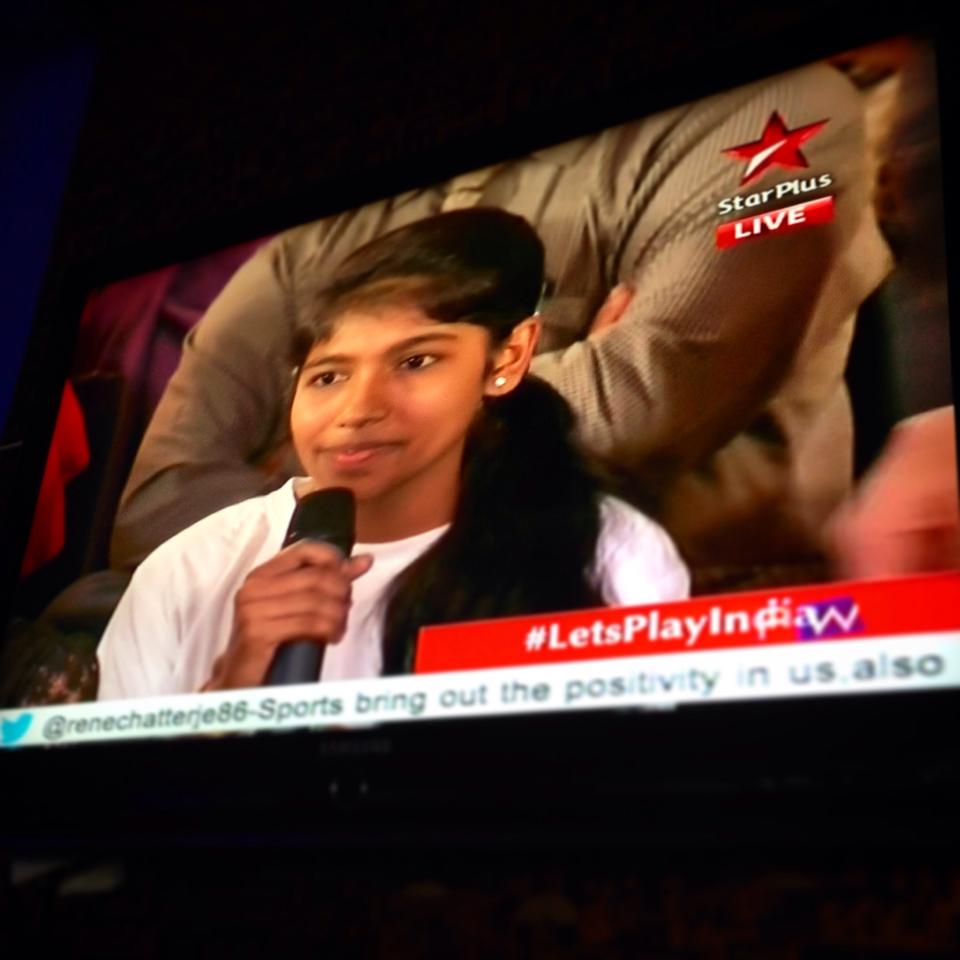
Priya Gupta, Head Girl at Khelshala was recently featured on Aamir Khan’s, a Bollywood actor and director’s live cable TV program filmed in Chandigarh, India. Aamir Khan and Kapil Dev, a former World Cup-winning Indian cricketer, were asked questions from the audience members, one of whom was Priya.
Priya Gupta, Head Girl at Khelshala on National TV in India.
The theme of the show was to discuss the concept of “sports for all” in India and how educational institutions can foster a greater balance between academics and sports. Programs like Khelshala are paving the way for disadvantaged youth to develop their sporting talents through education.
Priya’s appearance on national Indian TV, on behalf of Khelshala sets a great example for other Khelshala students to aspire to as well as raise awareness about the Khelshala – S.A.Y. – model in India. Thanks to Aamir Khan and Kapil Dev for hosting the show and helping to advance the sport for development and peace movement in India. The future for Khelshala looks brighter!
On Gandhi Jayanti, a national holiday in India to celebrate the birth of Mahatma Gandhi, my parents and I were invited to attend a filming at the Bright Lights Film Series at Emerson College courtesy of Dr. Sughra Raza, a family friend in Boston and editor of 3 Quarks Daily, an interdisciplinary filter blog.
Lauren Shaw, a Professor at Emerson’s Department of Visual and Media Arts produced Angkor’s Children through a culmination of several years of work with her Kickstarter campaign.
As a Founding Member and Secretary of Khelshala, it was an inspiring and humbling experience to meet Sreypov and Phunam, two of the Angkor children featured in the film as well as social entrepreneurs from the Cambodian Living Arts and Phare Cambodian Circus who worked for decades to mobilize the Cambodian diaspora in the United States and elsewhere to empower the next generation in Cambodia.
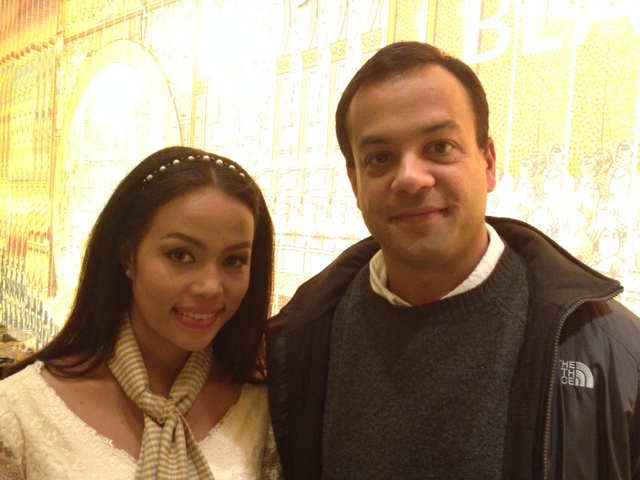
Sreypov of Angkor’s Children and me at Paramount Theater, Boston, MA.
What can Khelshala and others learn from those working to promote peace, development and human rights through the creative sector?
Sacrifice – the founders, artists and community members all had to give up something in their lives for the greater common good.
Commitment – staying true in the long term to their social justice cause was not expected, but came from within.
Community – an ecosystem of individuals and organizations nurtured the organizers to mobilize the diaspora.
Funding – sports and the arts are often first to be cut in public education.
Inter-generational dialogue – exchanges across generations in sport and music can keep traditions alive.
Over the years, I have been fortunate to attend several seminars, workshops and conferences related to sport for development and peace. Decision makers in this field often criticize practitioners (those who run organizations such as Kidsquash and Khelshala) for the lack of evidence-based research to demonstrate the return on investment in sport for development and peace.
Several years ago in a blog post, I made reference to discovering the literature on sport for development. To keep readers informed and promote learning, my colleagues in the International Sport for Development and Peace Association have mobilized academics across the globe to conduct greater research and study of the evolution of sport and social change. Those interested in learning more can read the open-access articles in the Journal of Sport for Development which caters to a wide audience ranging from students to decision makers.
This Journal is yet to publish research on the work of non-governmental organizations in India, such as Khelshala. Given India’s rising prominence in the global economy, the Trustees of Khelshala challenge students, teachers or professors to conduct field research with Khelshala on physical education, health and coaching as well as other disciplines to not only strengthen our effectiveness but promote knowledge-sharing. There are many possibilities for eager graduate students both within India and overseas to do qualitative and quantitative research that could potentially be published in the Journal of Sport for Development or others.
On 9th August, 2014, Khelshala celebrated its 5th anniversary in Chandigarh, India. Unfortunately I was unable to attend the event, but was celebrating in spirit with colleagues. Since I was not in Chandigarh to report on what took place, the India-based team are putting together a post-event synopsis.
Once again credit goes to Coach Bajwa and the Khelshala team for reaching this milestone. While there is still a long way to go, there continues to be significant achievements made by the Khelshala children as well as the program itself. For those interested in the details, these can be found in the Khelshala newsletter(s).
While I am thrilled to be part of Khelshala, this is a good time for self-reflection for one’s own journey. I have used this summer to review, assess and plan for further career development. After speaking with various career counselors about the field of social enterprise, I am reminded by a friend’s comment that “it would be good to do something that pays.”
Thanks to Tom Hodgson, a veteran teacher of philosophy and coach at Phillips Academy Andover (also a friend and squash colleague), he invited me to the SquashBusters Lawrence end-of-year celebration at Brooks School. SquashBusters Lawrence students, parents, staff, coaches and volunteers had fun with free-play, eating a pot-luck dinner and recognizing outstanding performers for the 2013-14 year.
SquashBusters Lawrence Staff recognizing students for 2013-14 achievements.
As an admirer and follower of SquashBusters, it was great to be in the company of Greg Zaff, CEO and Founder and his team to share developments about Khelshala in India as well as Kidsquash in Cambridge, MA. Given the National Urban Squash and Education Association’s international outreach to countries such as Colombia, South Africa and India (including Khelshala) – there is a lot of potential in terms of grant making, student-exchanges and North-South as well as South-South collaboration.
Though squash is not yet an Olympic sport, programs such as SquashBusters and the like – when done right with capable staff and adequate resources – produce balanced, active and socially responsible citizens. Surely this is a win-win for all stakeholders!





 Explorations in Sport for Development and Peace