Category Archives: Rehabilitation

Classical Tour of Ancient Greece: Will Squash Ever Make it to the Modern Olympics?

I recently traveled to Greece to expand upon my educational horizon and to deepen my understanding of the field of sport for development and peace. Before flying to Athens I conducted basic desk research with guidebooks and on the internet while consulting a few friends who had prior travel experience in the country. Ancient Greek civilization was not something that was taught in international schools back in the 1980s and 1990s in the Middle East but upon completing my undergraduate government major at Bowdoin College, I had briefly studied the work of Aristotle, Plato and Thucididyes. Of course, traveling to Greece more than 15 years later after graduation meant taking my appreciation for the people, place and culture to another level.

For 3-days, I was a tour group member of Classical Greece that made stops in Athens, Mycenae, Epidaurus, Olympia, and Delphi. The sites that were of most interest to me were Athens and Ancient Olympia. At every stop and corner there was evidence of historical significance. Learning about the details of all the players and events in the Classical Greece period could make for pursuing another educational degree altogether. This is not something that I am interested in doing at the moment, but believe that traveling is one of the greatest educational gifts one can make for oneself. Visiting the Panathenaic Stadium in Athens was moving because in a way it was a pilgrimage for paying homage to my playing and coaching days while helping to find my place in the world.
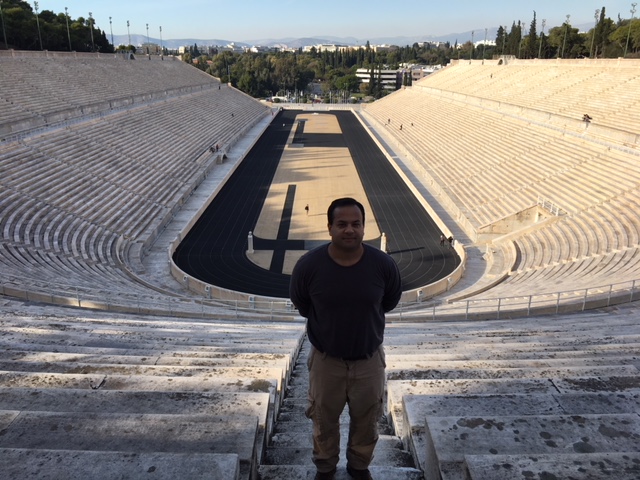
Tariq Mohammed’s visit to Panathenaic Stadium, Greece 2017. Photo credit: Unknown.

Visiting Ancient Olympia was of even more significance at it is where the Olympic flame for the Olympic Games are lit. I missed watching the ceremony in Ancient Olympia but was able to tour the grounds and see up close the ruins of this UNESCO Heritage Site. The Greeks had incredible foresight to have built such facilities thousands of years ago, but perhaps could do more to restore or renovate them to preserve such attractions today. Like other members of the tour group, I questioned myself. Why did I travel so far to see ruins and rubbles of dirt? As mentioned my approach was from the standpoint of (a) deepening my own understanding of sport for development and peace (b) being a symbolic advocate for squash in the Olympic movement and (c) being a part of something greater than myself and sharing with interesting travelers along the way.

Tariq Mohammed’s visit to Ancient Olympia, Greece, 2017 (Photo Credit: Andy Berbeck).

Through my travels and formal education, I have been influenced by several mentors and teachers which led to taking such a journey. I would like to acknowledge their influence as for doing so would provide greater context for my trip. Thomas Hodgson, former Philosophy instructor at Phillips Academy Andover, Denis Corish, former Philosophy professor at Bowdoin College, Alexis Lyras, Founder and Director of Olympus for Humanity Alliance, and Popy Dimoulas-Graham of Charity Republic, Inc. I am grateful to have been able to take the time to make such a trip and explore a new region of the world for myself and advocate for squash’s inclusion in the Modern Olympic Games.
Leave a comment

Filed under Capacity Buidling, Coaching, Corporate Social Responsibility, Education, International Development, Leadership, Leisure, Olympic, Paralympic, Peace Building, Professional Development, Recreation, Rehabilitation, Squash, Stakeholder Engagement

Turning a Weakness into a Strength

Since this blog has the word “explorations” in its title, I find it compelling to share my experiences from the vantage point of the 2017 United Nations International Year of Sustainable Tourism for Development. I’ve been fortunate to travel to several countries both as a child and adult which prompted me to self-reflect upon my tour of Spain in the spring of 2017. This does not make me a special person, but a traveler in life on this planet we call earth.

The slideshow above shows the magnificent architecture and beautiful countryside of Madrid, the capital city as well as Southern Spain. It is a country rich with culture and history, whose people are warm and friendly. Despite being a non-Spanish speaker and largely thanks to fellow travelers on my tour, I was able to navigate around Madrid and various Southern cities. My trip was a vacation, but I turned it into a project through my work in psychotherapy and volunteerism. I am not a trained therapist nor am I a certified peer specialist, but over the course of my adult years, I have gained increasing exposure to the world of mental health services.

I’ve enjoyed travel through my work and have learned that in many ways it is similar to coaching. It is worthwhile, to focus on the “process” so that the results will show for themselves. Perhaps, one of the reasons why I made the slideshow was to acknowledge and give importance to the challenges of travelers with mental health considerations. Particularly solo-travelers as the issues of navigation, housing, meals and medication adherence may be difficult without a relative or friend to assist.

Explorations are not only for explorers to visit or live in distance lands, but they can also be in one’s own backyard, town, city, state or country. As long as I am able to travel, there will always be something to write and reflect on which leads me to believe that perhaps my dream job would be as a travel writer or blogger.


Leave a comment

Filed under Capacity Buidling, Coaching, Education, Leisure, Networking, Psycho-Social Support, Public Policy, Recreation, Rehabilitation, Stakeholder Engagement, Volunteering

Promoting Volunteerism: How to Recruit and Manage Dedicated Volunteers?

Over the last several decades, there has been a lot of research, training and advocacy about volunteer recruitment and management in nonprofit manuals, websites and handbooks. A more recent strategy for recruiting volunteers and staff to become dedicated personnel is through the creation of online videos. For example, I recently registered and attended an orientation to become part of the 2017 Lowell Music Festival Volunteer Family. Here is a video produced by the Festival volunteers.

I found the online volunteer registration to be easy and efficient, plus the professional guidance and delivery of training from the National Park Service staff before the start of the 2017 Lowell Folk Festival was superb. My motivation for volunteering at the event was primarily to build upon my commitment to volunteerism for peace and development. This is the 31st year in which the Lowell Folk Festival has been running, mostly thanks to many dedicated volunteers and generous sponsors who keep the festival free of charge to the public.

My focus for this blog has been explorations in sport for development and peace, however, I have made occasional references to musical events and concerts as a means for bringing people together in peaceful settings. If you are unable to attend the Festival, many talented volunteers have created a tremendous Festival website with a wide array of information, including compelling music videos of the artists line-up to attract future Lowell Folk Festival doers and goers. I was introduced to the Lowell Folk Festival through my parents, aunts and uncles which brought the event to my attention and have also attended the Lowell Summer Music Series. Both the Festival and Music Series are worth it!


Leave a comment

Filed under Capacity Buidling, Community Development, Leadership, Leisure, Peace Building, Recreation, Rehabilitation, Volunteering

Revisiting and Sustaining Peace

Summers are a good time to catch up on reading, reviewing or preparing for what the new academic year may bring. It is a good time to clear out any unwanted materials, articles or books. Sometimes, I find things that I want to keep or share with others. This Dutch documentary titled, “Peace Beyond Borders,” was released in 2011 and would be an insightful source for a college professor teaching a class on East Africa or international mediation.

Thanks to the International Sports Alliance (formerly the Netherlands Sports Alliance), a sport for development and peace, advocacy group whose representatives I met at a conference in Trinidad and Tobago, I received a copy of the DVD. This documentary illustrates how sport can play a role in creating peaceful dialogues and act as a means for conflict resolution by way of getting two sides to the “negotiating table.” The pursuit of peace is a continuous process of refining assumptions and moving towards a compromise which both sides can tolerate.

Among the books, I have kept and continue to refer to is the 1991 work of Thich Nhat Hanh’s “Peace is Every Step: The Path of Mindfulness in Everyday Life.” I shall not write a book review, but rather recommend it for anyone going through a process of discovery or rehabilitation. There will be those who question definitions or states of peace, but an unknown source stated peace as “it does not mean to be in a place where there is no noise, trouble or hard work. It means to be in the midst of those things and still be calm in your heart.” Definitely not easy to do and sustain.

Leave a comment

Filed under Capacity Buidling, Coaching, Community Development, Conferences, Conflict Resolution, Education, Foreign Policy, International Development, Leadership, Literature Review, Networking, Peace Building, Professional Development, Rehabilitation

Health and Wellness at Global, Local (Glocal) and Personal Levels

On a global level, I would like to share the work of the Aga Khan Development Network which for the next year, starting from today (July 11, 2017) will be celebrating His Highness the Aga Khan’s Diamond Jubilee, or 60th year as the 49th hereditary Imam (spiritual leader) of the world’s Shia Ismaili Muslims. The AKDN videos below (shared on the organization’s website) are part of the press releases for this year- long celebration.

I am a firm believer in experiential education such as internships, study abroad and exchange programs. My paid internship (almost 20 years ago) with the Aga Khan Foundation USA in Washington DC was a highly rewarding and fulfilling professional experience which led to many exciting professional experiences and conversations in the realm of international development management. The Aga Khan Development Network’s pluralistic approach to international relations and local community development make its  programs compelling for both Sunnis and Shias as well as non-Muslims. Below is the positive impact of His Highnesses’ and AKDN’s work over the last 100 years.

At the local level, being a certified squash coach with ups and downs of mental illness, I am a strong believer in the health benefits of exercise and physical activity to aid in recovery. Through my ongoing professional and personal explorations in sport for development and peace at global and local levels, I would like to share a research study being conducted at Boston University’s Center for Psychiatric Rehabilitation on “Exercise and Cognitive Training, If there is anyone reading this blog, who knows of individuals who fit the parameters for the study, please contact the principal investigators.

The reason I am sharing this study is that this important research may advance the knowledge and capacity to effectively treat others with severe mental illness and support them with their recovery, whether it be in the United States or overseas, particularly in developing countries. Without going into details, I know how tough it can be for others struggling with mental illness and therefore can relate with what experts call “lived experience.”


Leave a comment

Filed under Capacity Buidling, Coaching, Community Development, Education, Foreign Policy, International Development, Leadership, Literature Review, Networking, Peace Building, Philanthropy, Private Public Partnerships, Professional Development, Psycho-Social Support, Rehabilitation, Volunteering

How does One Learn to Improvise?

When I was coaching high school squash I found myself often repeating the same training exercises and drills with students to build strong fundamentals. This was largely due to adjust for skill levels and therefore as students showed signs of improvement in their matches, I would like to believe that I began to improvise more. Perhaps not enough, though in my opinion.

Having spent a considerable amount of time away from squash practices, I have found other areas, most notably in jazz performances where improvisation is almost the norm. For athletic coaches in the Boston area, I strongly recommend attending the Mandorla Music Series in Somerville’s Third Life Studio to listen to world-class musicians at very affordable prices, in support of important humanitarian causes.

John Funkhouser’s Quartet (featuring Greg Loughman, a Bowdoin College faculty member) and John Kordalewski Trio featuring Carlos Pino & Kesivan Naidoo are two shows I was fortunate to watch and listen to live. Given the intimate setting, the musicians were very approachable and generous in sharing their love for music. Above is a song titled “The Deep,” by Professor John Funkhauser‘s Quartet, who have a cache for creating eclectic sounding instrumental jazz music. Improvising in sport and music, definitely go together.

Leave a comment

Filed under Capacity Buidling, Community Development, Education, Leadership, Leisure, Peace Building, Philanthropy, Professional Development, Psycho-Social Support, Rehabilitation, Stakeholder Engagement

What Happens to Athletic Coaches Living with Mental Illness?

I was diagnosed with schizo-affective disorder in 2014 after 2 psychotic episodes in my early to late twenties when I literally lost touch with reality. Thanks to excellent treatment by mental health professionals and unconditional support from my caregivers, I was able to go back to work, but relapsed in my late thirties after two suicides in my family and social networks. A  few life changes later, I was unable to follow instructions, process information and became socially anxious. Today it is a burden for me and my loved ones that I need to undergo rehabilitation and find a new direction for my life.

The world of sport is not immune to mental illness as it can strike anyone regardless of age, race or socio-economic background. There are many professional athletes who struggle daily with their illnesses. Some athletes, are open about their diagnoses while others suffer in silence. Unfortunately, the stigma of mental illness does not align well with high performance situations. Athletes, musicians and entertainers are no different from any other human beings on this planet. A 2012, New York Times article titled “With no one looking, mental illnesses can stay hidden,” prompts me to ask the question about what are the long term outcomes of athletic coaches with mental health conditions?

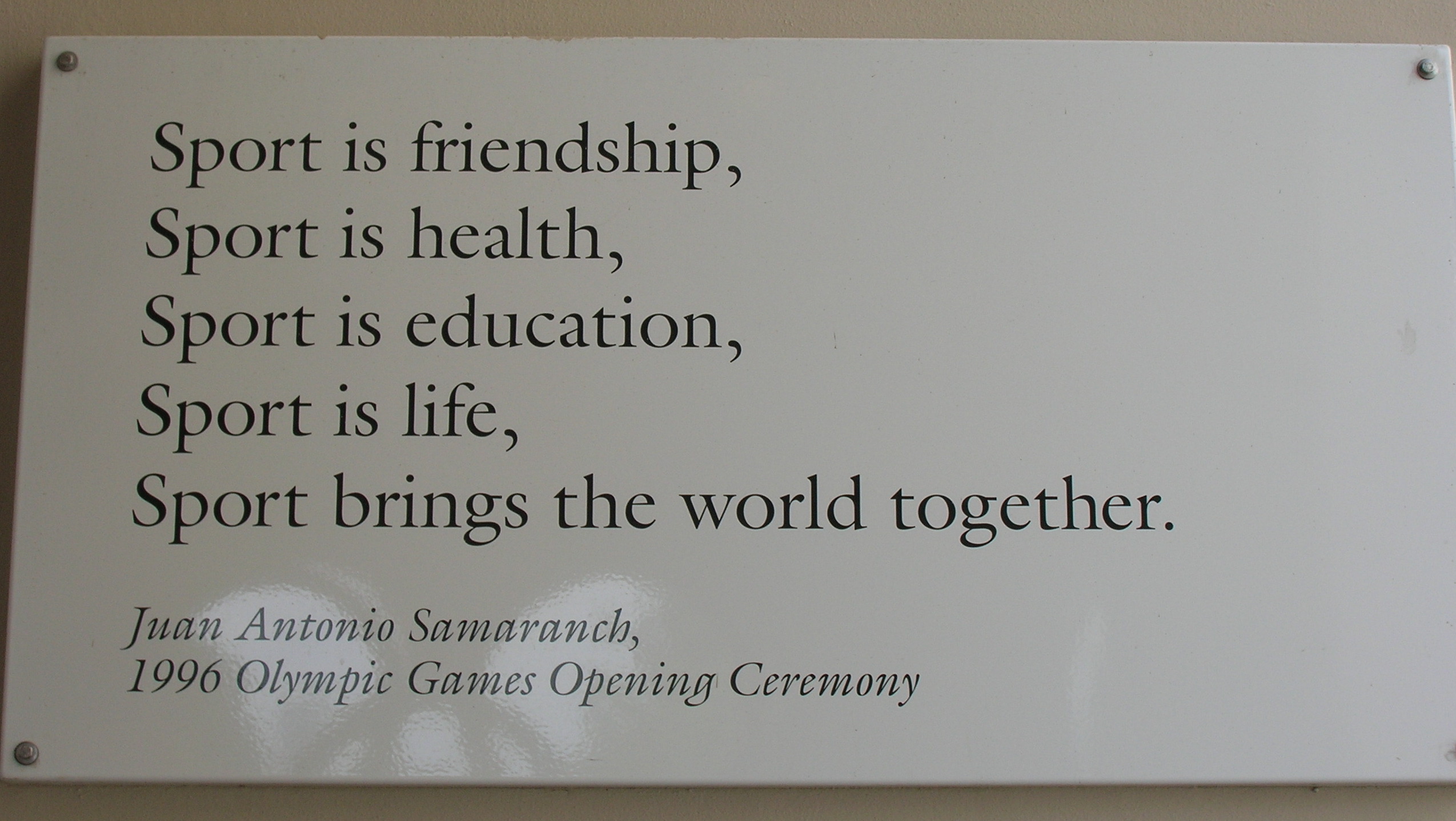
Visit to United States Olympic Training Center, Colorado, Colorado Springs. Photo credit: T. Mohammed, 2008.

Visit to United States Olympic Training Center, Colorado, Colorado Springs. Photo credit: T. Mohammed, 2008.

My illness has no cure and it is something I will have to manage carefully for the rest of my life, by taking medication and undergoing therapy. During the summer of 2008, my sister Miriam, invited me to visit Colorado where I visited the United States Olympic Center’s Training Center in Colorado Springs. At the Center, I saw the above inspirational quote by Juan Samaranch, former President of the International Olympic Committee. This resonated with me since my life has been enriched with, through and by sport. Setbacks occur, but life goes on. My onward journey will be to practice greater self-care and be a resource for others with mental illness, in a voluntary capacity, whenever possible.

Leave a comment

Filed under Coaching, Education, Poverty, Psycho-Social Support, Recreation, Rehabilitation, Youth Development, Youth Sport

Celebrating a Decade of Common Good Days

As a Bowdoin alum living in the Boston area I have enjoyed participating in the Common Good Days organized by the College. In 2016, the Bowdoin College Common Good Day in Boston was held at Pine Street Inn, a homeless shelter for men. Over the years, the College has selected different nonprofits across the country to perform a day of service. This year’s event saw almost 500 alumni, faculty, staff and friends participated in Common Good Days with various nonprofits in different cities. In Boston, there were 12 alumni and friends stationed in the Pine Street Inn kitchen to assist the staff with basic meal preparation.

img_8638

Bowdoin Alumni and Friends at 2016 Bowdoin College Common Good Day at Pine Street Inn, Boston, MA. Photo credit: Pine Street Inn Staff.

Alumni from a wide range of years, professional backgrounds and communities enthusiastically cooperated with the Pine Street Inn staff in helping to cut tomatoes, cucumbers, onions and chicken to make sandwiches for residents. Pine Street staff were generous with their time and guidance to offer a personalized tour of the facility to see how the shelter fulfills its mission. We shared stories of our Bowdoin years, previous volunteer experiences and current professional roles. Though we had never met before our common links through Bowdoin allowed us to focus on the task at hand while seeking a greater understanding of the significance of Common Good Day.

img_8635

Pine Street Inn Kitchen and Cafe. 2016 Photo credit: T. Mohammed

This marked for me a decade of participating in Common Good Days organized by the Bowdoin Club of Boston. Based on the conversations with fellow alumni at Pine Street Inn, the meaning of service varies from individual to individual. Being part of a group, working towards a common goal, helping to improve society all with a bit of fun – are some of the many reasons why people participate in such events. However, a humble suggestion for future Common Good Day planning could entail greater follow through and assessment of the impact of days of service events for long term sustainability of the organizations and individuals it aims to benefit.

Leave a comment

Filed under Capacity Buidling, Community Development, Education, Homelessness, Leadership, Networking, Philanthropy, Planning, Poverty, Psycho-Social Support, Rehabilitation, Stakeholder Engagement

Interdisciplinary Approaches to Sustainable Coaching

On a recent trip to Blacksburg, Virginia to visit Tim Baird, Professor of Geography at Virginia Tech who is a college friend from Maine, we took a hike in Jefferson National Forest. During the hike we encountered stunning natural scenery below and shared ideas and thoughts of our respective academic pursuits. At the outset, let me state that Professor Baird’s academic performance and training has won him many awards and admiration from his students.

IMG_8537

Signpost at Jefferson National Forest Photo credit: T. Mohammed

The 2016 Rio Olympics are being broadcast worldwide so I thought I would add my bit of sporting commentary on elite amateur athletes and the rest of us. Many of the athletes have been training rigorously over 4 years or more and aim to reach peak performance during competition at the Olympics. Michael Phelps, Simone Biles or Katie Ledecky are perfect examples of athletes who are reaching peak performances at this year’s Olympics.

IMG_8538

“Water in Stream” in Jefferson National Forest. Photo credit: T. Mohammed

Just like water in a stream (see photo above), my hike with Professor Baird, reminded me of my graduate school readings by Mihaly Csikzektmihalyi, a Hungarian psychologist known for his work on the concept of “flow,” in the field of positive psychology. The concept of “flow” has been applied in sport for development and peace and other disciplines.

According to Cziketmaihalyi and his 2004 TED Talk, everyone, be they an Olympian, student, coach or parent is always striving for their “A” game which means achieving a state of flow and staying in it. While Professor Baird and I are from different academic disciplines – geography and sport for development and peace  respectively- our liberal arts background allowed us to have an interdisciplinary discussion on sustainable coaching.

In Professor Baird’s case he was in the midst of publishing a new research paper on sustainable innovation which we also spoke about in depth. As for me, I am learning how to get “unstuck” and “out of my own way,” to stay in a state of flow in the field of sport for development and peace. Thanks Professor Baird for a terrific visit to Virginia and a meaningful hike!

Leave a comment

Filed under Capacity Buidling, Coaching, Education, International Development, Leisure, Literature Review, Networking, Olympic, Paralympic, Psycho-Social Support, Recreation, Rehabilitation, Uncategorized, Youth Development

Community Sport: What are Transferable Methodologies and Approaches?

The 2016 Olympics in Rio has generated terrific event in the Greater Boston area, like the one I attended yesterday with guest speakers such as Ellen Minzer, World Champion rower and award-winning coach. From her experience at elite levels of rowing and more recently as a coach to athletes with disabilities preparing for the Paralympics in Rio, Coach Minzer highlighted the importance of social inclusion in sport.

Among Coach Minzer, many coaching roles she serves as the Director of Outreach with Community Rowing Inc a sport-based youth development program based in Boston. In listening to Coach Minzer presentation, I began to see linkages in the aspirations of what Kidsquash was striving for in Boston and Khelshala in India. Comparisons can be made in community sport – such as rowing and squash – though executed differently by athletes during competition.

logo

Squash is mostly an individual sport in that during competition on the court it is one versus one, although there are team events too such as doubles squash with two versus two. Rowing is more of a team sport although there can be events with single sculling. The question for program directors of sport-based youth development programs from different community sports becomes what best practice in coaching rowing can be applied to squash or vice versa? What coaching methodologies do coaches use with differently aged and abled athletes? What coaching philosophies or approaches can program directors help to implement?

athletic-coaching-banner

These questions have societal consequences for all stakeholders in sport and beyond. This is why it is important to create more qualified coaches such as Coach Minzer who gives back to the sport, no matter what the level of the athletes, as they can help raise standards in community sport practice and participation. The Institute of Athletic Coach Education at Boston University is a fantastic resource for program directors and coaches to begin or enhance their professional development with sport-based youth development programs.

Leave a comment

Filed under Capacity Buidling, Coaching, Community Development, Conferences, Education, Gender, Leadership, Leisure, Networking, Paralympic, Professional Development, Rehabilitation, Stakeholder Engagement, Youth Development