Category Archives: Psycho-Social Support

Remembering my Grandfather through Sport for Development and Peace

This month is the death anniversary of Ataur Rahman, my grandfather (on my father’s side) who led a full life and left a tough act to follow. I have referenced in earlier blog posts how both my grandfather and father were football (soccer) enthusiasts in their younger days. My grandfather worked in the public sector all of his professional life and one of his many roles was as the Inspector General of Police.
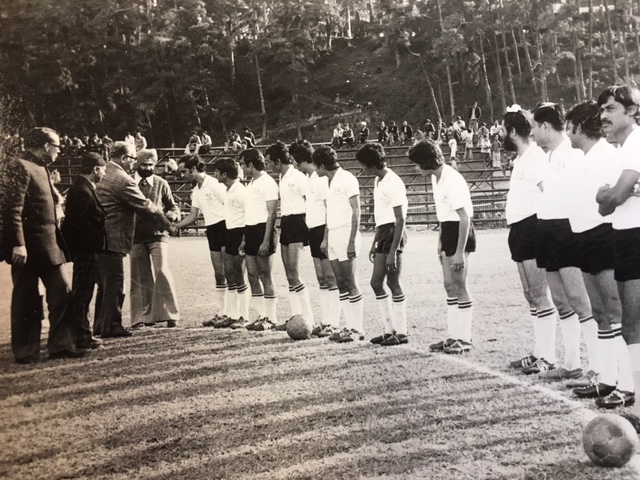
Ataur Rahman (my grandfather) shaking hands before the start of a police-sponsored soccer match.

Based off the accounts of family members, he was a senior police officer who enjoyed organizing sports events for fellow police officers and was asked to present prizes. This was an effective community building tool as it helped foster friendships among officers and their families as well as improve the morale of officers striving to uphold the rule of law in the state.

Ataur Rahman (my grandfather) in center back with dignitaries and police soccer teams.

I was not born when many of these happenings occurred, but do remember his later years as a Member of Parliament and then as a retired public official. While he was passionate about his work, his family life was just as important if not more. We miss him dearly and know that he is in a better place.
 

1 Comment

Filed under Community Development, Education, Leadership, Leisure, Networking, Peace Building, Psycho-Social Support, Recreation, Stakeholder Engagement

Health and Wellness at Global, Local (Glocal) and Personal Levels

On a global level, I would like to share the work of the Aga Khan Development Network which for the next year, starting from today (July 11, 2017) will be celebrating His Highness the Aga Khan’s Diamond Jubilee, or 60th year as the 49th hereditary Imam (spiritual leader) of the world’s Shia Ismaili Muslims. The AKDN videos below (shared on the organization’s website) are part of the press releases for this year- long celebration.

I am a firm believer in experiential education such as internships, study abroad and exchange programs. My paid internship (almost 20 years ago) with the Aga Khan Foundation USA in Washington DC was a highly rewarding and fulfilling professional experience which led to many exciting professional experiences and conversations in the realm of international development management. The Aga Khan Development Network’s pluralistic approach to international relations and local community development make its  programs compelling for both Sunnis and Shias as well as non-Muslims. Below is the positive impact of His Highnesses’ and AKDN’s work over the last 100 years.

At the local level, being a certified squash coach with ups and downs of mental illness, I am a strong believer in the health benefits of exercise and physical activity to aid in recovery. Through my ongoing professional and personal explorations in sport for development and peace at global and local levels, I would like to share a research study being conducted at Boston University’s Center for Psychiatric Rehabilitation on “Exercise and Cognitive Training, If there is anyone reading this blog, who knows of individuals who fit the parameters for the study, please contact the principal investigators.

The reason I am sharing this study is that this important research may advance the knowledge and capacity to effectively treat others with severe mental illness and support them with their recovery, whether it be in the United States or overseas, particularly in developing countries. Without going into details, I know how tough it can be for others struggling with mental illness and therefore can relate with what experts call “lived experience.”


Leave a comment

Filed under Capacity Buidling, Coaching, Community Development, Education, Foreign Policy, International Development, Leadership, Literature Review, Networking, Peace Building, Philanthropy, Private Public Partnerships, Professional Development, Psycho-Social Support, Rehabilitation, Volunteering

My Evolution as a Developmental Coach

Today happens to be my Mom’s birthday and the month in which Mothers are celebrated, among other national and international awareness activities (such as Mental Health Awareness Month). To readers of my blog, I hope you have a few minutes to read this post.

I’ve made a couple of references to my parents on this blog largely because I know it is thanks to them and many others, that I am able to stay healthy, volunteer my time with causes I care about and explore new places and things.

The video above is a culmination of my journey in squash. I have enjoyed every moment of playing, coaching and volunteering in squash at various levels, as well as being a team member on winning and losing teams.

I plan to stay physically active with and without squash, as it definitely keeps me well and balanced. Thanks, Mom and Happy Birthday!


1 Comment

Filed under Capacity Buidling, Coaching, Community Development, Conferences, Corporate Social Responsibility, Education, Foreign Policy, Gender, International Development, Leadership, Leisure, Networking, Olympic, Peace Building, Philanthropy, Poverty, Private Public Partnerships, Professional Development, Psycho-Social Support, Recreation, Squash, Volunteering, Youth Development, Youth Sport

How does One Learn to Improvise?

When I was coaching high school squash I found myself often repeating the same training exercises and drills with students to build strong fundamentals. This was largely due to adjust for skill levels and therefore as students showed signs of improvement in their matches, I would like to believe that I began to improvise more. Perhaps not enough, though in my opinion.

Having spent a considerable amount of time away from squash practices, I have found other areas, most notably in jazz performances where improvisation is almost the norm. For athletic coaches in the Boston area, I strongly recommend attending the Mandorla Music Series in Somerville’s Third Life Studio to listen to world-class musicians at very affordable prices, in support of important humanitarian causes.

John Funkhouser’s Quartet (featuring Greg Loughman, a Bowdoin College faculty member) and John Kordalewski Trio featuring Carlos Pino & Kesivan Naidoo are two shows I was fortunate to watch and listen to live. Given the intimate setting, the musicians were very approachable and generous in sharing their love for music. Above is a song titled “The Deep,” by Professor John Funkhauser‘s Quartet, who have a cache for creating eclectic sounding instrumental jazz music. Improvising in sport and music, definitely go together.

Leave a comment

Filed under Capacity Buidling, Community Development, Education, Leadership, Leisure, Peace Building, Philanthropy, Professional Development, Psycho-Social Support, Rehabilitation, Stakeholder Engagement

Comedy Sportz: Improvising Your Game While Laughing

Recently on a Friday evening, I visited the Riot Theater in Jamaica Plain, Boston, Massachusetts where I was fortunate to watch Comedy Sportz for my first time who are a fantastic group of improvisational actors. Without out really knowing much about the group or the content show I was blown away by their creative spin on blending creativity, dynamism and humor.

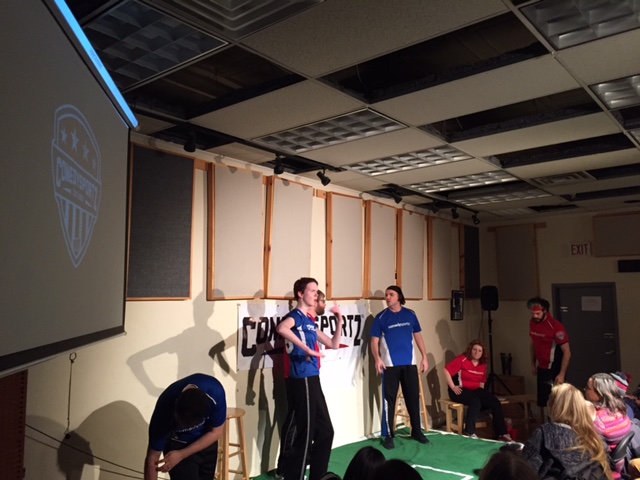
Comedy Sportz actors in The Zone at the Riot Theater. Photo credit. T. Mohammed, 2017.

Comedy Sportz actors in The Zone at the Riot Theater. Photo credit. T. Mohammed, 2017.

The Riot Theater is the Comedy Sportz, first location in the Greater Boston area. Being someone who has observed a fair amount of sports coaching, I was really struck by the actors energy, wit and participatory audience. In many ways coaching and teaching is like acting and so it was interesting to observe how others perform and what they can do better than some experienced but less theatrical coaches or teachers.

Courtney Pong, the Referee (GM and Owner) of Comedy Sportz,Boston leading the show.

Courtney Pong, the Referee (GM and Owner) of Comedy Sportz,Boston leading the show.

The way the show is structured has a sports element to it with a red team and a blue team with one referee plus scoreboard. Just like a sporting contest they are all in uniforms and are guided by the referee to play certain type of improvisational games. Audience participation is encouraged who are upwards of 7 years old. It is a great family atmosphere with candy for kids too! I hadn’t laughed in a long time and left in stitches. No pun intended.

Leave a comment

Filed under Capacity Buidling, Coaching, Community Development, Education, Gender, Leisure, Networking, Professional Development, Psycho-Social Support, Recreation, Stakeholder Engagement

What Happens to Athletic Coaches Living with Mental Illness?

I was diagnosed with schizo-affective disorder in 2014 after 2 psychotic episodes in my early to late twenties when I literally lost touch with reality. Thanks to excellent treatment by mental health professionals and unconditional support from my caregivers, I was able to go back to work, but relapsed in my late thirties after two suicides in my family and social networks. A  few life changes later, I was unable to follow instructions, process information and became socially anxious. Today it is a burden for me and my loved ones that I need to undergo rehabilitation and find a new direction for my life.

The world of sport is not immune to mental illness as it can strike anyone regardless of age, race or socio-economic background. There are many professional athletes who struggle daily with their illnesses. Some athletes, are open about their diagnoses while others suffer in silence. Unfortunately, the stigma of mental illness does not align well with high performance situations. Athletes, musicians and entertainers are no different from any other human beings on this planet. A 2012, New York Times article titled “With no one looking, mental illnesses can stay hidden,” prompts me to ask the question about what are the long term outcomes of athletic coaches with mental health conditions?

Visit to United States Olympic Training Center, Colorado, Colorado Springs. Photo credit: T. Mohammed, 2008.

Visit to United States Olympic Training Center, Colorado, Colorado Springs. Photo credit: T. Mohammed, 2008.

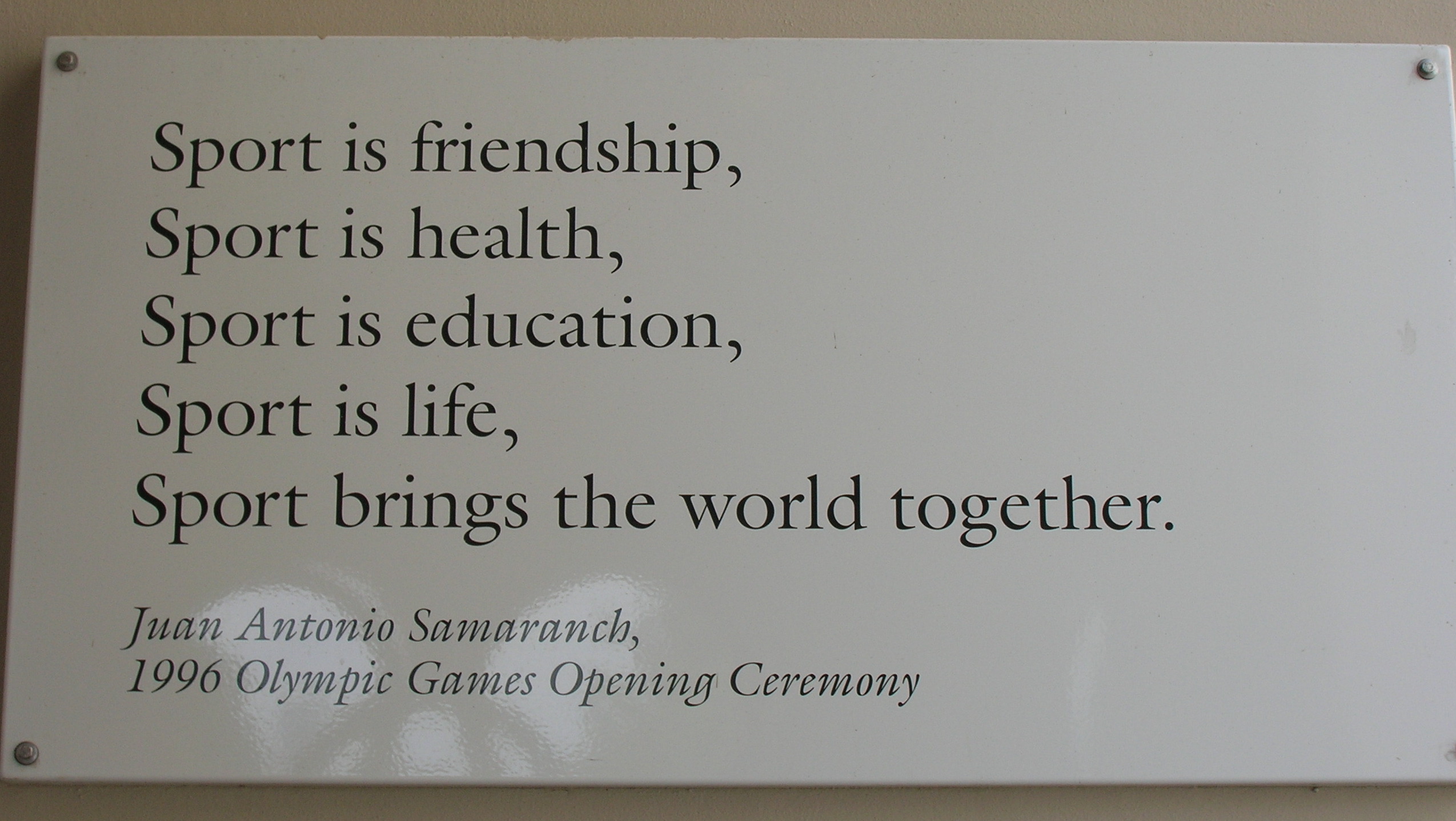
My illness has no cure and it is something I will have to manage carefully for the rest of my life, by taking medication and undergoing therapy. During the summer of 2008, my sister Miriam, invited me to visit Colorado where I visited the United States Olympic Center’s Training Center in Colorado Springs. At the Center, I saw the above inspirational quote by Juan Samaranch, former President of the International Olympic Committee. This resonated with me since my life has been enriched with, through and by sport. Setbacks occur, but life goes on. My onward journey will be to practice greater self-care and be a resource for others with mental illness, in a voluntary capacity, whenever possible.

Leave a comment

Filed under Coaching, Education, Poverty, Psycho-Social Support, Recreation, Rehabilitation, Youth Development, Youth Sport

Celebrating a Decade of Common Good Days

As a Bowdoin alum living in the Boston area I have enjoyed participating in the Common Good Days organized by the College. In 2016, the Bowdoin College Common Good Day in Boston was held at Pine Street Inn, a homeless shelter for men. Over the years, the College has selected different nonprofits across the country to perform a day of service. This year’s event saw almost 500 alumni, faculty, staff and friends participated in Common Good Days with various nonprofits in different cities. In Boston, there were 12 alumni and friends stationed in the Pine Street Inn kitchen to assist the staff with basic meal preparation.

img_8638

Bowdoin Alumni and Friends at 2016 Bowdoin College Common Good Day at Pine Street Inn, Boston, MA. Photo credit: Pine Street Inn Staff.

Alumni from a wide range of years, professional backgrounds and communities enthusiastically cooperated with the Pine Street Inn staff in helping to cut tomatoes, cucumbers, onions and chicken to make sandwiches for residents. Pine Street staff were generous with their time and guidance to offer a personalized tour of the facility to see how the shelter fulfills its mission. We shared stories of our Bowdoin years, previous volunteer experiences and current professional roles. Though we had never met before our common links through Bowdoin allowed us to focus on the task at hand while seeking a greater understanding of the significance of Common Good Day.

img_8635

Pine Street Inn Kitchen and Cafe. 2016 Photo credit: T. Mohammed

This marked for me a decade of participating in Common Good Days organized by the Bowdoin Club of Boston. Based on the conversations with fellow alumni at Pine Street Inn, the meaning of service varies from individual to individual. Being part of a group, working towards a common goal, helping to improve society all with a bit of fun – are some of the many reasons why people participate in such events. However, a humble suggestion for future Common Good Day planning could entail greater follow through and assessment of the impact of days of service events for long term sustainability of the organizations and individuals it aims to benefit.

Leave a comment

Filed under Capacity Buidling, Community Development, Education, Homelessness, Leadership, Networking, Philanthropy, Planning, Poverty, Psycho-Social Support, Rehabilitation, Stakeholder Engagement

Practicing Being Present with Yourself in Non-Sport Settings

Thanks to the Boston Public Library’s Honan-Allston Branch, which makes Adult Coloring books available to the public, one can practice being present with oneself. This may seem a little far from a student-athlete’s reality. Nonetheless, I am all for mixing up one’s training and approach to maintain interest and focus on training.

Photo credit: T.Mohammed, 2016.

“Ancient Mexican Designs,” by Marty Noble, Photo credit: T.Mohammed, 2016.

There is a small selection of adult coloring books along with erasable coloring pencils. Above is one of the books which I chose to do my practice. I have to say it felt like being a kid all over again in kindergarten, but I was surprised how I felt after I completed the coloring in the drawings (see below). There were three things I noticed from this exercise. They were a sense of concentration, calm and achievement.

Photo credit: T. Mohammed, 2016.

Drawing by Marty Noble in “Ancient Mexican Designs,” and coloring by Tariq Mohammed. Photo credit: T. Mohammed, 2016.

Of course, I don’t want to blow such a simple exercise out of proportion when applying it to the field of sport for development and peace. However, it does have value for children, adolescents and even young adults to practice being in the moment. The end result are the finished pieces of art for which in an educational setting can provide students with a sense of accomplishment and pride. Even adults need this from time to time. Thanks again to Boston Public Library!.

Photo credit: T. Mohammed, 2016.

Drawing by Marty Noble in “Ancient Mexican Designs,” and coloring by Tariq Mohammed. Photo credit: T. Mohammed, 2016.

Leave a comment

Filed under Coaching, Education, Leisure, Literature Review, Peace Building, Psycho-Social Support, Youth Development

Interdisciplinary Approaches to Sustainable Coaching

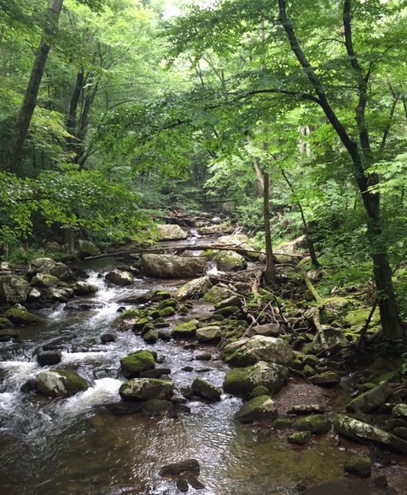
On a recent trip to Blacksburg, Virginia to visit Tim Baird, Professor of Geography at Virginia Tech who is a college friend from Maine, we took a hike in Jefferson National Forest. During the hike we encountered stunning natural scenery below and shared ideas and thoughts of our respective academic pursuits. At the outset, let me state that Professor Baird’s academic performance and training has won him many awards and admiration from his students.

IMG_8537

Signpost at Jefferson National Forest Photo credit: T. Mohammed

The 2016 Rio Olympics are being broadcast worldwide so I thought I would add my bit of sporting commentary on elite amateur athletes and the rest of us. Many of the athletes have been training rigorously over 4 years or more and aim to reach peak performance during competition at the Olympics. Michael Phelps, Simone Biles or Katie Ledecky are perfect examples of athletes who are reaching peak performances at this year’s Olympics.

IMG_8538

“Water in Stream” in Jefferson National Forest. Photo credit: T. Mohammed

Just like water in a stream (see photo above), my hike with Professor Baird, reminded me of my graduate school readings by Mihaly Csikzektmihalyi, a Hungarian psychologist known for his work on the concept of “flow,” in the field of positive psychology. The concept of “flow” has been applied in sport for development and peace and other disciplines.

According to Cziketmaihalyi and his 2004 TED Talk, everyone, be they an Olympian, student, coach or parent is always striving for their “A” game which means achieving a state of flow and staying in it. While Professor Baird and I are from different academic disciplines – geography and sport for development and peace  respectively- our liberal arts background allowed us to have an interdisciplinary discussion on sustainable coaching.

In Professor Baird’s case he was in the midst of publishing a new research paper on sustainable innovation which we also spoke about in depth. As for me, I am learning how to get “unstuck” and “out of my own way,” to stay in a state of flow in the field of sport for development and peace. Thanks Professor Baird for a terrific visit to Virginia and a meaningful hike!

Leave a comment

Filed under Capacity Buidling, Coaching, Education, International Development, Leisure, Literature Review, Networking, Olympic, Paralympic, Psycho-Social Support, Recreation, Rehabilitation, Uncategorized, Youth Development

Striving for Meditation and Mindfulness On and Off the Court

I recently traveled to the beautiful state of Oregon for a family vacation. It was my first visit to Oregon and home state of the world headquarters of Nike. I did inquire with my Uber driver about the possibility of doing a tour of the Nike campus but it was closed for the weekend.

However, my parents and I visited the Portland Japanese Garden which was a great reminder of the art of practicing mindfulness and meditation. The stones, waterfalls and fauna all created a sense of calm that Jon Kabat Zinn once spoke about during a lecture I attended in Boston’s Arlington Street Church.

Portland Japanese Garden

Visit to Portland Japanese Garden Photo Credit: T.Mohammed

Mindfulness and meditation are methods of coaching that are very much in the news and being written about by academics, medical professionals and sport researchers. Amy Baltzell recently published a book with several authors on Mindfulness and Performance and Sam Parfitt leads the True Athlete Project which both reinforce the sporting applications for mindfulness and meditation. The science behind meditation and mindfulness is helping with the evolution of sport for development and peace as a form of daily practice to aspire towards.

Leave a comment

Filed under Coaching, Education, Leisure, Literature Review, Networking, Psycho-Social Support, Recreation, Rehabilitation