Sport and philanthropy is a decades old practice for many professional athletes, both active and retired. As ambassadors of their sport, the athletes establish family foundations or have supported the work of existing philanthropic organizations through their charitable work.
An international development project which allowed me to gain first-hand exposure to sport and philanthropy was while helping to organize a fundraiser in 2002 for the Harvard Dominican Initiative. The premise was to leverage diaspora for philanthropic efforts, to reap rewards for community members both in the homeland and adopted countries.
Hall of Fame pitcher, Pedro Martinez of the Boston Red Sox is one example – of many professional athletes – who has given back to his native country – the Dominican Republic – by raising funds and awareness for a variety of social and economic issues. Pedro’s generosity and appreciation towards baseball fans was demonstrated when he donated hundreds of Red Sox tickets and personally autographed baseballs to help raise money for progressive causes. All attendees of the event co-sponsored by Harvard, received a baseball autographed by Pedro Martinez.
Pedro Martinez, Hall of Fame pitcher of the Boston Red Sox autographed baseball. Photo credit: T. Mohammed, 2017.
Professional athletes and celebrities bring star power to philanthropy. They can help fuel donations to important causes and help bring about positive social change to communities at the local, national and international levels. This is considered a best practice and a win-win for stakeholders. Essentially professional athletes and professional ambassadors remind us of the importance of good stewardship to help balance people, planet and profits.
Today happens to be my Mom’s birthday and the month in which Mothers are celebrated, among other national and international awareness activities (such as Mental Health Awareness Month). To readers of my blog, I hope you have a few minutes to read this post.
I’ve made a couple of references to my parents on this blog largely because I know it is thanks to them and many others, that I am able to stay healthy, volunteer my time with causes I care about and explore new places and things.
The video above is a culmination of my journey in squash. I have enjoyed every moment of playing, coaching and volunteering in squash at various levels, as well as being a team member on winning and losing teams.
I plan to stay physically active with and without squash, as it definitely keeps me well and balanced. Thanks, Mom and Happy Birthday!
A concise, thorough and inspiring presentation, entitled “More Than A Game: Using Soccer to Create a Level Playing Field for Girls” was be led by Ben Sanders, Director of Programmes, Grassroot Soccer South Africa. Grassroot Soccer is an adolescent health organization that leverages the power of soccer to educate, inspire, and mobilize youth in developing countries to overcome their greatest health challenges, live healthier, more productive lives, and be agents for change in their communities.
The USAID Sport for Development M&E Learning Lab is a platform that allows USAID Missions, NGOs, academics, corporate partners and donors to identify and examine evaluation outcomes of programs that use sport to achieve development goals. Group members use this platform to share knowledge, identify best practices, and disseminate research outcomes. Through open information exchange and collaboration, the platform allows members to support the advancement of sport for development and peace programs globally.
Mr. Sanders and his colleagues also referenced a report and digital storytelling to share best practices and lessons learned from Grassroots Soccer. Both are highly recommended for additional reading and viewing. Overall, participating in the seminar was a cost-effective method of keeping up with one of the leading sport for development organizations in the world. Khelshala and others NGOs have a lot to learn from Grassroot Soccer.
A few years ago I blogged about what the field of sports for development and peace can learn from the arts? Music is often considered a great communication tool to bring people together. There have been many types of benefit concerts during my lifetime. The LiveAid, Farm Aid and Live 8 concerts are some of the larger benefit concerts that have happened across the globe. Patrick Kabanda, a friend at the Office of the Chief Economist at the World Bank, has written extensively about the importance of the arts to economic and social development. His publications offer great insights.
I recently attended a Lampedusa, a Concert for Refugees in Boston at the Berklee College of Music. It was a sold out show with humorous dialogue and well crafted songs by all the musicians. Clearly, such an event is a win-win situation for the musicians, fans, sponsors and aid recipients. Small scale concerts may be just as good as large scale events in that they can draw loyal fans and supporters. Professional athletes and musicians are often grouped together in the entertainment business which may lead to ease of working together. Personally, the Lampedusa tour stop in Boston, happened to be on my birthday which made it all the more special and memorable.
As a member of the International Sport for Development and Peace Association (ISDPA), I would urge my colleagues in the field to explore ways in which benefit concerts can be used as a fundraising tool to benefit disadvantaged athletes. Choosing which non-governmental organization to benefit from the concerts could be done based on pooling of resources. For example ISDPA, could collect the funds and make equal distributions to its member organizations. In the United States, Up2Us, a sport-based youth development coalition would be a good starting point. An event organizer, may ask is there a demand for such a concert to benefit disadvantaged athletes? My answer would be, just ask around and you never know if there are a group of musicians passionate about similar issues.
Thanks to big data and increasingly shared datasets, the concept of youth development is being qualitatively measured across countries. The Commonwealth Secretariat recently released its third “Global Youth Development Index and Report” to measure how young people in 183 countries are positioned for the future.
Source: Artistic interpretation of Youth Development in Key West, Florida. Photo Credit: T. Mohammed, 2015.
The report uses 5 domains which the authors see as critical to youth development: education, health, employment civic participation and political participation. My previous post gave examples of social entrepreneurs and policy makers working to achieve the United Nations’ Sustainable Development Goals. This report acts as an impressive data-advocacy tool to focus attention and investment where needed the most.
The Commonwealth Secretariat’s Global Youth Development Index (GYDI) allows the public to compare and contrast countries where youth development is going well and not so well. Based on the GYDI, what attention and investment can you or your organization make in youth development?
It is really amazing how much there is to learn from being in a library. There are numerous types of libraries across the country on college campuses, in almost every neighborhood as public libraries and then the elite Presidential libraries to identify a few. The Boston Public Library in Copley Square, a newly renovated library in the heart of Boston reaches out to its community in numerous ways.
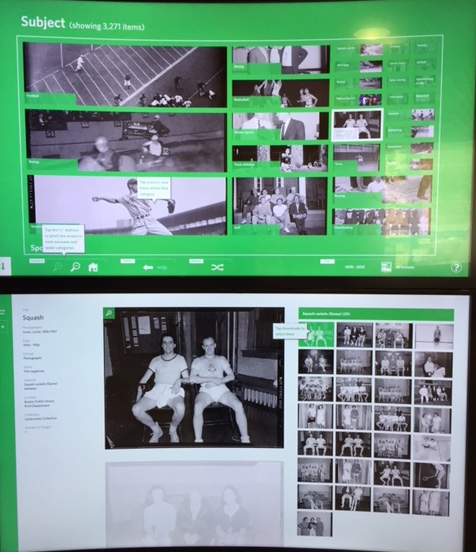
Squash Photos of Bostonions at the Boston Public Library’s Electronic Information Kiosk. Photo Credit: T.Mohammed.
On a recent visit to the newly renovated Boston Public Library in Copley Square, I came across a fascinating electronic information kiosks in the main entrance hall. At a touch screen information kiosk, there was an archive of photos of various subjects (including squash photos of Bostonians as seen above) from the City of Boston. If you click on the photo you can see the details.
This impressive kiosk with information retrieval and storage (at a cost to the taxpayers of Massachusetts) is a tremendous leap forward in understanding and connecting the sport for development and peace field to the general public. My suggestion for the many aspiring young professionals in the emerging field of sport for development and peace would be to examine the evolution of sport at your local library. You may be surprised what you find.
Since taking a break from coaching squash – an indoor winter sport in New England – I have had the opportunity to explore outdoor recreational and sporting activities this summer. Being on the water in the summertime can be very invigorating and many New Englanders are avid sailors, rowers and yachtsmen. Most of the coastal cities or towns in this area have some type of community boating program.
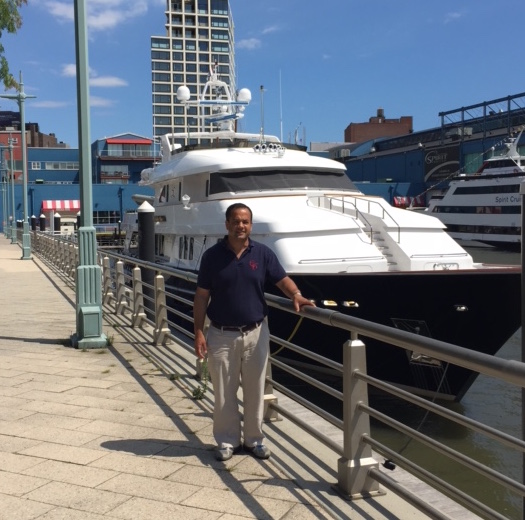
I was born in Dubai – a port city in the United Arab Emirates and have traveled through many coastal cities and towns over the years in New England and overseas. Some of these stops include Maine, Connecticut and Rhode Island in New England and Kochi, Kolkatta and Mumbai in India to name a few. One recent stop included New York City at Chelsea Piers (see below) where on the Hudson River New Yorkers and tourists could rent yachts, sailboats and windsurfers for recreational purposes.
Visit to Chelsea Piers, New York, 2016. Photo credit: unknown.
Coastal cities and towns be they in New England or not play an important role in promoting tourism, leisure and economic development. Community boating programs are another means in which to foster community, share common experiences and develop new friendships. Coastal cities and towns also promote competitive water sports such as the Volvo Ocean Race or off-shore Powerboat Racing. Of course there are some within the sporting world who are purists and might question the athleticism required to partake in such activities.
Youth sport specialization and the desire to compete at the collegiate level places a considerable burden on families in terms of time, money and energy which can lead to a very narrow focus in their child’s education. Perhaps specialization, limits a coach’s ability to see other perspectives, especially when trying to coach their own sport if they grew up with just one or two sports. Just as youth sport researchers and advocates urge parents not to let their children specialize in sport too early, I think the same could go for coaches in that they may benefit from coach observations and learning from other sports to improve their own coaching toolkit. In short, quality coaching is a mix of science and art that enables students to reach their full potential.
As you are probably aware this blog is outdated and no longer being updated. I didn’t want to stop without being able to reflect with you upon three lessons gained from life experiences, which I believe can be one of our greatest teachers. My hope is that it will help you think about your own life.
The first lesson was learned while I was a high school student in the United Arab Emirates. This was among the several countries my siblings and I grew up.
After a long day at school, I decided to go for a run to take my mind off homework. At the time, Laylah, my youngest sister was the only person home. I asked her to let my parents know that I had gone for a run and that I would be back home in time for dinner. Little did I know I would not make it home for dinner that evening.
I set forth on my usual route with Walkman in hand. (For those of you too young to remember what a Walkman is, it is one of the early precursors to the iPod). My memory of what happened next is unclear. All I remember is waking up in a hospital emergency room and my entire upper body soaked in blood with my mother at my bedside. I have no recollection of how I ended up there.
From police reports it appeared that while running, I was knocked down and unconscious by a car. Except for the shattered glass that had scared my face and back, there were, fortunately, no serious injuries. No broken bones. No lost limbs. Nonetheless, doctors told me that I had experienced a severe shock to the body and mind (deemed a concussion) and that I would need to miss the remainder of my 11th grade.
On one hand I was relieved, that I wouldn’t have to take final exams, but on the other hand disappointed that I had to stay home and could not spend time with fellow classmates. During the recovery, I had time to reflect upon the seriousness of what had happened and came to the conclusion I had a near death experience.
At first this troubled me, but as I thought more deeply I came to understand that I had been given a second chance to live. I felt fortunate to be blessed with a miracle. While not everyone believes in God, I do believe there is a force greater than humanity.
Some call this force God. Some call it Jesus. Some call it Allah. I’m not a very religious person, but I could not help think about this force. It kept me alive and is why I am here today. Thus the first lesson, I would like to share with you is that, I believe, we are each here to serve a purpose.
My second lesson stems from an international childhood and brief career in international affairs. I am an American citizen of Indian heritage but was born in the United Arab Emirates and educated in the United Kingdom, Saudi Arabia, India and the United States. My multicultural upbringing might appear unique, but there are a growing number of Americans and international students, who also hail from diverse backgrounds and venture to and from foreign lands.
During 2003-2004 I served as a United Nations Volunteer under Kofi Annan, former Secretary General’s initiative called United Nations Information Technology Service (UNITeS) in Kampala, Uganda to promote volunteerism as well as foster peace and sustainable development. Based at Makerere University, a leading institution of higher education in East Africa, I was living in a country with a history of Indophobia.
In the early 1970s, Idi Amin, a former President of Uganda expelled thousands of Indian immigrants due to fear of economic insecurity for ethnic Ugandans. Fast-forward to present day Uganda, Indians are gradually returning to Uganda – mostly in small numbers – to reclaim their properties.
Given the historical plight of Indians in Uganda I was anxious as to how I would be received by my Ugandan counterparts. Would they see me as another Indian threatening their livelihood? Would I be considered a naïve, twenty something Indian-American aid worker imposing Western values? Would they just accept me for my ideas, thoughts and actions while being a guest in their country?
My mission in Uganda was to strengthen and expand the Cisco Networking Academy Program, a global online curriculum for schools and universities across the country. The Cisco program prepares students and working professionals to design, build and maintain computer networks.
I am not an expert in networking computers, but did have prior work experience publishing research on the intersection of business, technology and policy under the direction of Jeffrey Sachs, a highly acclaimed economist, at the Center for International Development at Harvard’s Kennedy School of Government.
Fortunately with hard work, openness and a willingness to learn about Ugandan culture I was able to build trust among Ugandan colleagues. Living in a foreign country, far away from family and close friends, I learned how to make new friends and appreciate how human bonds tie us together. This is what truly enriches our lives.
At Concord Academy everyone is valued for their individuality and at the same time their is a respect of common beliefs. Hence, the second lesson I would like to share with you is that while everyone is unique in their own way, we must not forget to celebrate our common values in this increasingly complex world.
My third lesson is a culmination from my lifelong passion for squash – the sport, not the vegetable (Although after living in New England, I have also grown to like squash soup!). I became acquainted with the sport when my mother would go for her squash lessons.
Curious to know how this racquet sport was played, I eventually made my way on to a squash court by the age of 12. Living in Saudi Arabia it was also a way to beat the heat and exercise in an air-conditioned room.
Looking back, squash has opened many doors for me. During my college admissions process Dan Hammond, an All-American squash player at West Point and Head Squash Coach at Bowdoin College, a highly selective liberal arts college in Maine, actively recruited me as a student-athlete. I would not have gained admission based solely on my academics. Squash opened the door.
Also, my first paycheck in the United States was thanks to squash. During the summer of my freshmen year in college, I worked as a counselor at the Harvard Junior Squash Camp under the direction Bill Doyle, a former Head Squash Coach at Harvard. Squash opened the door.
During my junior year of college I was invited to attend an alumni function with key donors and was seated, by the organizers, at a table with Robert Edwards, a former President of Bowdoin College and his wife, along with several accomplished alumni.
Puzzled at first, I came to understand that I was selected to be seated at that particular table, not because of my academic prowess, but because I happened to be co-captain of the varsity squash team under the direction of Satinder Bajwa, a world renowned squash coach who was subsequently the Head Squash Coach at Bowdoin College during my senior year. Looking back, meeting Baj (as he is known in the squash world), was a tremendous, positive life-changing experience.
Squash has continued to provide many opportunities even after college. For instance I got my first desk job at Harvard, because Geoffrey Kirkman, Managing Director of the Information Technologies Group at the Center for International Development liked the fact that I was a squash player and coach who showed promise beyond academics.
Again, if it were not for my interest in squash, I would not have been able to coach at various New England colleges, universities and prep schools. Neither would I have had the opportunity to help implement the 2006 Super Series Squash Finals, featuring the world’s top 8 players in London, England.
Neither would I have received a travel grant to visit a poor village in India to conduct coaching clinics for underprivileged children. I could go on.
I am very grateful and honored for being involved with Khelshala, a non-governmental organization, that allows me to play a part in helping other students can gain education and career opportunities through sport. Thus the third, lesson I would like to share with you is that don’t underestimate the value of your extra-curricular activities.
In short, my three lessons for you are: (i) live a purposeful life because you never know when it may end (ii) embrace all the diversity the world has to offer and remain inclusive and (iii) last, but not least, don’t forget to nurture your talents. It sounds simple to say, but, at times, it can be difficult to put into practice.
My name is Tariq Mohammed, which among other things, in Arabic means “he who knocks at the door.”
On 9th August, 2014, Khelshala celebrated its 5th anniversary in Chandigarh, India. Unfortunately I was unable to attend the event, but was celebrating in spirit with colleagues. Since I was not in Chandigarh to report on what took place, the India-based team are putting together a post-event synopsis.
Once again credit goes to Coach Bajwa and the Khelshala team for reaching this milestone. While there is still a long way to go, there continues to be significant achievements made by the Khelshala children as well as the program itself. For those interested in the details, these can be found in the Khelshala newsletter(s).
While I am thrilled to be part of Khelshala, this is a good time for self-reflection for one’s own journey. I have used this summer to review, assess and plan for further career development. After speaking with various career counselors about the field of social enterprise, I am reminded by a friend’s comment that “it would be good to do something that pays.”
All age groups were welcomed to the event to participate whole heartedly and take part in lifetime sports, such as dance, aerobics, yoga, athletics, squash, tennis, badminton and table-tennis, which were made available for the day. The Khelshala and Majra children joined hands to commence a day of great importance not only for the Khelshala community, but also for the sports society as a whole. The sound of the Dhols, kicked off the Khelshala march in which a group of very enthusiastic local community members arrived to participate in the walk towards the Khel-Mel venue.
Preceding the march, the dance activity conducted by Mr. Sameer Mahajan, Director of Rockstar Academy, lifted the spirits of the children and energized them for a day packed with fun activities. Along with explaining the importance of dance and aerobics in maintaining health and wellbeing of oneself, he began with a warm up before teaching the children chorography he had planned for the session. The dance session was followed by yoga and meditation conducted by Pinki Jha explaining how yoga and meditation can make their minds sharp, peaceful and also how it can enhance their day to day well being, if practiced regularly. In addition, various athletic activities including hurdles and cone drills for agility over a 50m track were conducted by coaches from Panjab University, Chandigarh. Also, many other individual games like squash, tennis, badminton, and table-tennis were a part of the overall day and were managed by friends and volunteers. Our very own Khelshala coach, Mr. Anil Rathee, also directed a tennis tournament. Khelshala children also performed a street play. This was greatly enjoyed by everybody, especially by the group of St. John’s School children in attendance. Khel-Mel activities ended with a grand finale of tug of war competition.
To conclude the proceedings a small prize giving ceremony was hosted by Mr. Bajwa, Founder and Trustee of Khelshala. He also shared with everyone on how sport can help them to stay fit and healthy. The event coverage was carried out by the esteemed Doordarshan channel, and Langar (community lunch) was served to all attending, courtesy of Village Majra Panchayat.
We were truly delighted to have celebrated this United Nations initiative and hope it served the vision and mission of spreading awareness among the community promoting development and peace. We look forward to a bigger and better event next year. We hope to see you in 2015.


 Explorations in Sport for Development and Peace