On a global level, I would like to share the work of the Aga Khan Development Network which for the next year, starting from today (July 11, 2017) will be celebrating His Highness the Aga Khan’s Diamond Jubilee, or 60th year as the 49th hereditary Imam (spiritual leader) of the world’s Shia Ismaili Muslims. The AKDN videos below (shared on the organization’s website) are part of the press releases for this year- long celebration.
I am a firm believer in experiential education such as internships, study abroad and exchange programs. My paid internship (almost 20 years ago) with the Aga Khan Foundation USA in Washington DC was a highly rewarding and fulfilling professional experience which led to many exciting professional experiences and conversations in the realm of international development management. The Aga Khan Development Network’s pluralistic approach to international relations and local community development make its programs compelling for both Sunnis and Shias as well as non-Muslims. Below is the positive impact of His Highnesses’ and AKDN’s work over the last 100 years.
At the local level, being a certified squash coach with ups and downs of mental illness, I am a strong believer in the health benefits of exercise and physical activity to aid in recovery. Through my ongoing professional and personal explorations in sport for development and peace at global and local levels, I would like to share a research study being conducted at Boston University’s Center for Psychiatric Rehabilitation on “Exercise and Cognitive Training,“ If there is anyone reading this blog, who knows of individuals who fit the parameters for the study, please contact the principal investigators.
The reason I am sharing this study is that this important research may advance the knowledge and capacity to effectively treat others with severe mental illness and support them with their recovery, whether it be in the United States or overseas, particularly in developing countries. Without going into details, I know how tough it can be for others struggling with mental illness and therefore can relate with what experts call “lived experience.”
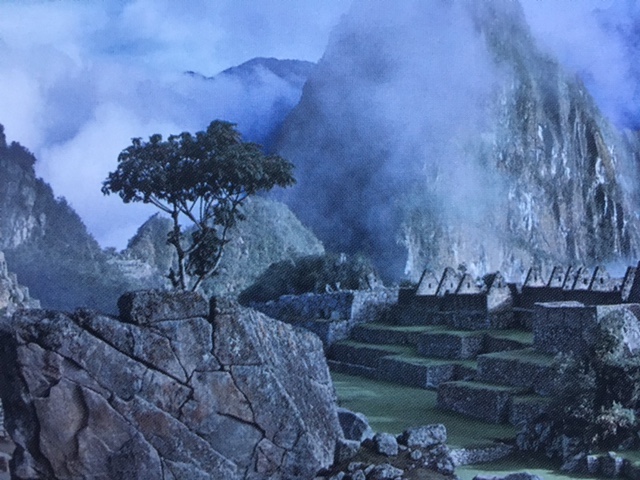
I recently returned from a 2 week tour of Southern Peru with stops in tourist destinations such as Cusco and Machu Picchu as well as the Sacred Valley. This was my first visit to a South American country and I chose Peru for a number of reasons. First, old friends and colleagues inspired me to visit, second, I was fascinated by Machu Picchu and third, I wanted to use up my vacation time wisely. Hiking up to Machu Picchu has always intrigued me.
Machu Picchu, Peru – a UNESCO World Heritage Site.
There were several highlights from my stay in Peru, but I would like to focus on the most striking issues relevant to sport for development and peace, that I was fortunate to witness. Throughout my travels in Asia and Africa, I have had little experience interacting with indigenous people, but while in Puno, Peru a visit to Lake Titicaca‘s Uros island gave me a glimpse of the impact of modern life (including sport and recreation) on the Uros people.
Uros people on Lake Titicaca, Peru Photo credit: Tour company, 2017.
Traveling with a group of Western tourists, we were taken by boat from Puno to Lake Titicaca where we visited Uros island. When we arrived on the island we were greeted by a warm elderly woman dressed in bright, traditional attire who guided us to a semi-circular seating area. After being seated on reed benches, she gave us an overview of life on the island of Uros and its culture with the aide of a translator.
Interestingly, the island itself is made of reeds which are grown and stacked to produced a floating surface which is finally completed by playing sports, such as soccer and basketball to make the “ground” compact. This gives a whole new meaning to the concept of turf, especially in a remote region of the world. The Uros are connected to the modern world by modern communication and transportation systems, yet they retain their culture and way of life with a touch of sport.
Today happens to be my Mom’s birthday and the month in which Mothers are celebrated, among other national and international awareness activities (such as Mental Health Awareness Month). To readers of my blog, I hope you have a few minutes to read this post.
I’ve made a couple of references to my parents on this blog largely because I know it is thanks to them and many others, that I am able to stay healthy, volunteer my time with causes I care about and explore new places and things.
The video above is a culmination of my journey in squash. I have enjoyed every moment of playing, coaching and volunteering in squash at various levels, as well as being a team member on winning and losing teams.
I plan to stay physically active with and without squash, as it definitely keeps me well and balanced. Thanks, Mom and Happy Birthday!
When I was coaching high school squash I found myself often repeating the same training exercises and drills with students to build strong fundamentals. This was largely due to adjust for skill levels and therefore as students showed signs of improvement in their matches, I would like to believe that I began to improvise more. Perhaps not enough, though in my opinion.
Having spent a considerable amount of time away from squash practices, I have found other areas, most notably in jazz performances where improvisation is almost the norm. For athletic coaches in the Boston area, I strongly recommend attending the Mandorla Music Series in Somerville’s Third Life Studio to listen to world-class musicians at very affordable prices, in support of important humanitarian causes.
John Funkhouser’s Quartet (featuring Greg Loughman, a Bowdoin College faculty member) and John Kordalewski Trio featuring Carlos Pino & Kesivan Naidoo are two shows I was fortunate to watch and listen to live. Given the intimate setting, the musicians were very approachable and generous in sharing their love for music. Above is a song titled “The Deep,” by Professor John Funkhauser‘s Quartet, who have a cache for creating eclectic sounding instrumental jazz music. Improvising in sport and music, definitely go together.
A Bowdoin squash alum introduced me to VolunteerMatch, a wonderful website that connects nonprofit organizations with volunteers. Hence, in an effort to continue volunteering locally I was matched with Emmaus Inc, a Haverhill, Massachusetts-based nonprofit organization that addresses homelessness through empowerment. How did this happen?
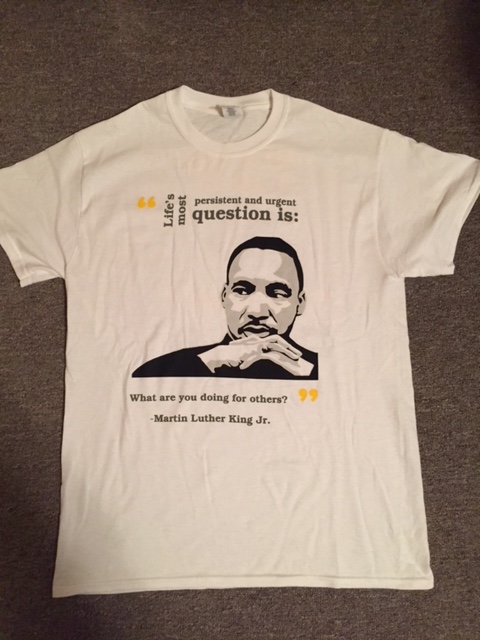
Emmaus Volunteers received the T-shirt above for its 4th Annual 2017 Martin Luther King Day of Service.
The process to act upon my volunteer interest was to register with VolunteerMatch, express interest in organizations and causes near my zip code and then select volunteer opportunities based on mutual interest and availability. My first onsite meeting with Emmaus’s Empowerment Project Coordinator facilitated registration, identification verification and completing background (CORI) checks. I was then emailed by the coordinator the general volunteer responsibilities.
As a Family Guide, my volunteer role for the 2017 Emmaus Martin Luther King Day MLK Day was to provide a welcoming atmosphere for disadvantaged families and individuals at the Resource Fair and Family Theater Almost 200 people from the Haverhill community attended the event and Emmaus Inc had over 130 volunteers respond to the call to work on various MLK day projects. Each volunteer received a free T-shirt, as seen above. For more information, check out pictures from the event on the Emmaus Inc. social media pages! Thank you to VolunteerMatch for helping me to make the Emmaus event a success.
If you are looking for ways to give back to your local community, connect with like-minded individuals and organizations as well as ease your way your back to full-time paid employment, VolunteerMatch, might be a useful tool to make your next steps in the new year.
A few years ago I blogged about what the field of sports for development and peace can learn from the arts? Music is often considered a great communication tool to bring people together. There have been many types of benefit concerts during my lifetime. The LiveAid, Farm Aid and Live 8 concerts are some of the larger benefit concerts that have happened across the globe. Patrick Kabanda, a friend at the Office of the Chief Economist at the World Bank, has written extensively about the importance of the arts to economic and social development. His publications offer great insights.
I recently attended a Lampedusa, a Concert for Refugees in Boston at the Berklee College of Music. It was a sold out show with humorous dialogue and well crafted songs by all the musicians. Clearly, such an event is a win-win situation for the musicians, fans, sponsors and aid recipients. Small scale concerts may be just as good as large scale events in that they can draw loyal fans and supporters. Professional athletes and musicians are often grouped together in the entertainment business which may lead to ease of working together. Personally, the Lampedusa tour stop in Boston, happened to be on my birthday which made it all the more special and memorable.
As a member of the International Sport for Development and Peace Association (ISDPA), I would urge my colleagues in the field to explore ways in which benefit concerts can be used as a fundraising tool to benefit disadvantaged athletes. Choosing which non-governmental organization to benefit from the concerts could be done based on pooling of resources. For example ISDPA, could collect the funds and make equal distributions to its member organizations. In the United States, Up2Us, a sport-based youth development coalition would be a good starting point. An event organizer, may ask is there a demand for such a concert to benefit disadvantaged athletes? My answer would be, just ask around and you never know if there are a group of musicians passionate about similar issues.
The 2016 Positive Peace Report by the Institute of Economics and Peace, helps non-experts understand what peace looks like from a macro perspective. I found the diagram below from the report to be a very noteworthy depiction of what the positive elements of peace look like for a nation. I shall not repeat the content of the report, but would like to elaborate on a couple of contemporary issues.
Source: 2016 Positive Peace Report by Institute of Economics and Peace.
The humanitarian crisis in Syria according to Ban Ki-Moon, Secretary General of the United Nations is “appauling,” with the thousands of deaths, especially young children. The Secretary General and the international community are taking steps for a peaceful solution to the conflict using diplomatic tools and maneuvers for a constructive dialogue that intends to put an end to the violence. However, many innocent Syrians and peacekeepers are being caught in the middle of the violence.
Approximately 5 years ago, I had the honor and privilege of attending a retreat with Thich Nhat Hanh, a Buddhist monk who has authored many self-help books on health and wellness. Perhaps the Syrian government and its people would benefit from listening, reading and learning from Thich Nhat Hanh’s teachings. When a cease-fire is reached by the Syrians themselves, they may wish to look at themselves in the mirror and make peace with themselves. In my humble opinion, by rejecting violence, it is easier to accept peace.
Thanks to the Boston Public Library’s Honan-Allston Branch, which makes Adult Coloring books available to the public, one can practice being present with oneself. This may seem a little far from a student-athlete’s reality. Nonetheless, I am all for mixing up one’s training and approach to maintain interest and focus on training.
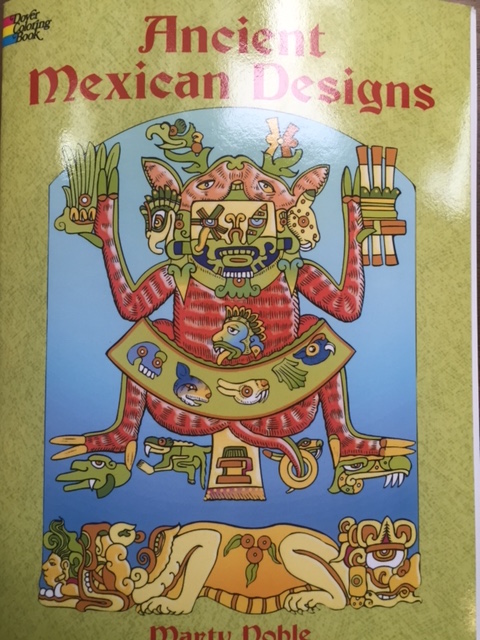
“Ancient Mexican Designs,” by Marty Noble, Photo credit: T.Mohammed, 2016.
There is a small selection of adult coloring books along with erasable coloring pencils. Above is one of the books which I chose to do my practice. I have to say it felt like being a kid all over again in kindergarten, but I was surprised how I felt after I completed the coloring in the drawings (see below). There were three things I noticed from this exercise. They were a sense of concentration, calm and achievement.
Drawing by Marty Noble in “Ancient Mexican Designs,” and coloring by Tariq Mohammed. Photo credit: T. Mohammed, 2016.
Of course, I don’t want to blow such a simple exercise out of proportion when applying it to the field of sport for development and peace. However, it does have value for children, adolescents and even young adults to practice being in the moment. The end result are the finished pieces of art for which in an educational setting can provide students with a sense of accomplishment and pride. Even adults need this from time to time. Thanks again to Boston Public Library!.
Drawing by Marty Noble in “Ancient Mexican Designs,” and coloring by Tariq Mohammed. Photo credit: T. Mohammed, 2016.
The Stevens Memorial Library in North Andover, MA has a wonderful 2016 summer sport film series which is free and open to the public. As part of my exploration in sport and development, I chose to watch the movie 42, for the first time which is a biographical portrayal about Jackie Robinson. Race and racism, unfortunately still exists in America today as we have seen by the repeated incidents of gun violence.
When I was a teenager in Saudi Arabia and India in the late 1980s and early 1990s, one did not know much of the struggles of Jackie Robinson and his role in the civil rights movement in the United States. Perhaps this was ignorance or because one was consumed by the political events in the Persian Gulf. Today, being a naturalized American of color, I am even more moved by the words “we shall overcome” and Jackie’s story of resilience and courage.
I have blogged about Khelshala, a sport-based youth development program in Chandigarh, India – founded by Coach Satinder Bajwa – the first person of color to be the Head Coach of Harvard Men’s and Women’s Squash – but I have not given much thought to how Khelshala and its mission fits with the wider world of sport.
It helps to understand the legacies of Jackie Robinson and more recently the passing of Mohammad Ali also known as the “The Greatest” and put squash -a minor sport – into context. James Zug, an American author of Squash: A History of the Game, which mostly discusses the sport in the United States of America is seen as the go-to-guy on writing books about squash. Zug acknowledges squash players of color (such as Anil Nayar of Harvard, Wendell Chestnut of Williams College and of course Hashim Khan, the legendary squash professional of the Khan squash dynasty) who like Jackie Robinson “squash barriers.”
“Squashing barriers” is the essence of Khelshala (an international affiliate of the National Urban Squash and Education Association) in India where social stratification is common. Just as Mahatma Gandhi served as a source of inspiration to Martin Luther King, perhaps Jackie Robinson’s story will serve as a source of inspiration to the children of Khelshala and many others around the world.
As you are probably aware this blog is outdated and no longer being updated. I didn’t want to stop without being able to reflect with you upon three lessons gained from life experiences, which I believe can be one of our greatest teachers. My hope is that it will help you think about your own life.
The first lesson was learned while I was a high school student in the United Arab Emirates. This was among the several countries my siblings and I grew up.
After a long day at school, I decided to go for a run to take my mind off homework. At the time, Laylah, my youngest sister was the only person home. I asked her to let my parents know that I had gone for a run and that I would be back home in time for dinner. Little did I know I would not make it home for dinner that evening.
I set forth on my usual route with Walkman in hand. (For those of you too young to remember what a Walkman is, it is one of the early precursors to the iPod). My memory of what happened next is unclear. All I remember is waking up in a hospital emergency room and my entire upper body soaked in blood with my mother at my bedside. I have no recollection of how I ended up there.
From police reports it appeared that while running, I was knocked down and unconscious by a car. Except for the shattered glass that had scared my face and back, there were, fortunately, no serious injuries. No broken bones. No lost limbs. Nonetheless, doctors told me that I had experienced a severe shock to the body and mind (deemed a concussion) and that I would need to miss the remainder of my 11th grade.
On one hand I was relieved, that I wouldn’t have to take final exams, but on the other hand disappointed that I had to stay home and could not spend time with fellow classmates. During the recovery, I had time to reflect upon the seriousness of what had happened and came to the conclusion I had a near death experience.
At first this troubled me, but as I thought more deeply I came to understand that I had been given a second chance to live. I felt fortunate to be blessed with a miracle. While not everyone believes in God, I do believe there is a force greater than humanity.
Some call this force God. Some call it Jesus. Some call it Allah. I’m not a very religious person, but I could not help think about this force. It kept me alive and is why I am here today. Thus the first lesson, I would like to share with you is that, I believe, we are each here to serve a purpose.
My second lesson stems from an international childhood and brief career in international affairs. I am an American citizen of Indian heritage but was born in the United Arab Emirates and educated in the United Kingdom, Saudi Arabia, India and the United States. My multicultural upbringing might appear unique, but there are a growing number of Americans and international students, who also hail from diverse backgrounds and venture to and from foreign lands.
During 2003-2004 I served as a United Nations Volunteer under Kofi Annan, former Secretary General’s initiative called United Nations Information Technology Service (UNITeS) in Kampala, Uganda to promote volunteerism as well as foster peace and sustainable development. Based at Makerere University, a leading institution of higher education in East Africa, I was living in a country with a history of Indophobia.
In the early 1970s, Idi Amin, a former President of Uganda expelled thousands of Indian immigrants due to fear of economic insecurity for ethnic Ugandans. Fast-forward to present day Uganda, Indians are gradually returning to Uganda – mostly in small numbers – to reclaim their properties.
Given the historical plight of Indians in Uganda I was anxious as to how I would be received by my Ugandan counterparts. Would they see me as another Indian threatening their livelihood? Would I be considered a naïve, twenty something Indian-American aid worker imposing Western values? Would they just accept me for my ideas, thoughts and actions while being a guest in their country?
My mission in Uganda was to strengthen and expand the Cisco Networking Academy Program, a global online curriculum for schools and universities across the country. The Cisco program prepares students and working professionals to design, build and maintain computer networks.
I am not an expert in networking computers, but did have prior work experience publishing research on the intersection of business, technology and policy under the direction of Jeffrey Sachs, a highly acclaimed economist, at the Center for International Development at Harvard’s Kennedy School of Government.
Fortunately with hard work, openness and a willingness to learn about Ugandan culture I was able to build trust among Ugandan colleagues. Living in a foreign country, far away from family and close friends, I learned how to make new friends and appreciate how human bonds tie us together. This is what truly enriches our lives.
At Concord Academy everyone is valued for their individuality and at the same time their is a respect of common beliefs. Hence, the second lesson I would like to share with you is that while everyone is unique in their own way, we must not forget to celebrate our common values in this increasingly complex world.
My third lesson is a culmination from my lifelong passion for squash – the sport, not the vegetable (Although after living in New England, I have also grown to like squash soup!). I became acquainted with the sport when my mother would go for her squash lessons.
Curious to know how this racquet sport was played, I eventually made my way on to a squash court by the age of 12. Living in Saudi Arabia it was also a way to beat the heat and exercise in an air-conditioned room.
Looking back, squash has opened many doors for me. During my college admissions process Dan Hammond, an All-American squash player at West Point and Head Squash Coach at Bowdoin College, a highly selective liberal arts college in Maine, actively recruited me as a student-athlete. I would not have gained admission based solely on my academics. Squash opened the door.
Also, my first paycheck in the United States was thanks to squash. During the summer of my freshmen year in college, I worked as a counselor at the Harvard Junior Squash Camp under the direction Bill Doyle, a former Head Squash Coach at Harvard. Squash opened the door.
During my junior year of college I was invited to attend an alumni function with key donors and was seated, by the organizers, at a table with Robert Edwards, a former President of Bowdoin College and his wife, along with several accomplished alumni.
Puzzled at first, I came to understand that I was selected to be seated at that particular table, not because of my academic prowess, but because I happened to be co-captain of the varsity squash team under the direction of Satinder Bajwa, a world renowned squash coach who was subsequently the Head Squash Coach at Bowdoin College during my senior year. Looking back, meeting Baj (as he is known in the squash world), was a tremendous, positive life-changing experience.
Squash has continued to provide many opportunities even after college. For instance I got my first desk job at Harvard, because Geoffrey Kirkman, Managing Director of the Information Technologies Group at the Center for International Development liked the fact that I was a squash player and coach who showed promise beyond academics.
Again, if it were not for my interest in squash, I would not have been able to coach at various New England colleges, universities and prep schools. Neither would I have had the opportunity to help implement the 2006 Super Series Squash Finals, featuring the world’s top 8 players in London, England.
Neither would I have received a travel grant to visit a poor village in India to conduct coaching clinics for underprivileged children. I could go on.
I am very grateful and honored for being involved with Khelshala, a non-governmental organization, that allows me to play a part in helping other students can gain education and career opportunities through sport. Thus the third, lesson I would like to share with you is that don’t underestimate the value of your extra-curricular activities.
In short, my three lessons for you are: (i) live a purposeful life because you never know when it may end (ii) embrace all the diversity the world has to offer and remain inclusive and (iii) last, but not least, don’t forget to nurture your talents. It sounds simple to say, but, at times, it can be difficult to put into practice.
My name is Tariq Mohammed, which among other things, in Arabic means “he who knocks at the door.”





 Explorations in Sport for Development and Peace