Category Archives: Networking

Comedy Sportz: Improvising Your Game While Laughing

Recently on a Friday evening, I visited the Riot Theater in Jamaica Plain, Boston, Massachusetts where I was fortunate to watch Comedy Sportz for my first time who are a fantastic group of improvisational actors. Without out really knowing much about the group or the content show I was blown away by their creative spin on blending creativity, dynamism and humor.
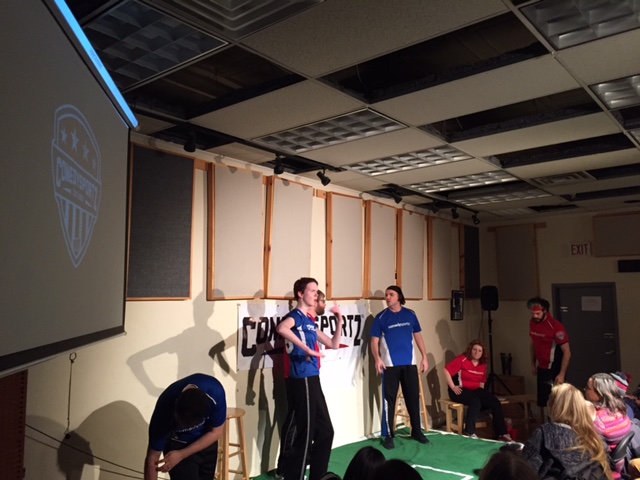
Comedy Sportz actors in The Zone at the Riot Theater. Photo credit. T. Mohammed, 2017.

Comedy Sportz actors in The Zone at the Riot Theater. Photo credit. T. Mohammed, 2017.

The Riot Theater is the Comedy Sportz, first location in the Greater Boston area. Being someone who has observed a fair amount of sports coaching, I was really struck by the actors energy, wit and participatory audience. In many ways coaching and teaching is like acting and so it was interesting to observe how others perform and what they can do better than some experienced but less theatrical coaches or teachers.

Courtney Pong, the Referee (GM and Owner) of Comedy Sportz,Boston leading the show.

Courtney Pong, the Referee (GM and Owner) of Comedy Sportz,Boston leading the show.

The way the show is structured has a sports element to it with a red team and a blue team with one referee plus scoreboard. Just like a sporting contest they are all in uniforms and are guided by the referee to play certain type of improvisational games. Audience participation is encouraged who are upwards of 7 years old. It is a great family atmosphere with candy for kids too! I hadn’t laughed in a long time and left in stitches. No pun intended.
Leave a comment

Filed under Capacity Buidling, Coaching, Community Development, Education, Gender, Leisure, Networking, Professional Development, Psycho-Social Support, Recreation, Stakeholder Engagement

2017 Emmaus Martin Luther King Day of Service

Bowdoin squash alum introduced me to VolunteerMatch, a wonderful website that connects nonprofit organizations with volunteers. Hence, in an effort to continue volunteering locally I was matched with Emmaus Inc, a Haverhill, Massachusetts-based nonprofit organization that addresses homelessness through empowerment. How did this happen?

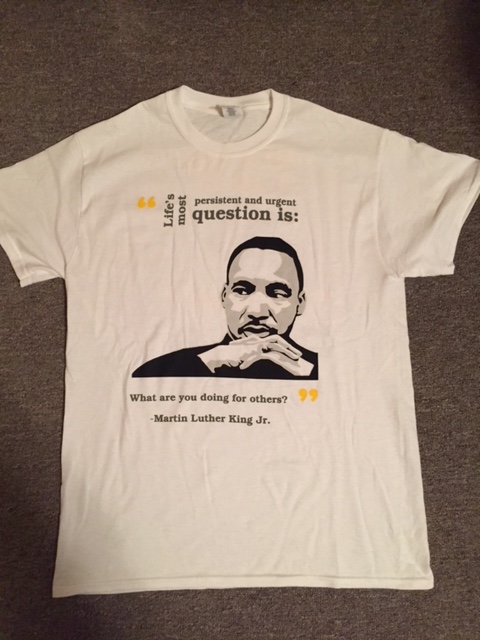
T-shirt for Emmaus Volunteers, special event for 2017 MLK Day of Service.

Emmaus Volunteers received the T-shirt above for its 4th Annual 2017 Martin Luther King Day of Service.

The process to act upon my volunteer interest was to register with VolunteerMatch, express interest in organizations and causes near my zip code and then select volunteer opportunities based on mutual interest and availability. My first onsite meeting with Emmaus’s Empowerment Project Coordinator facilitated registration, identification verification and completing background (CORI) checks. I was then emailed by the coordinator the general volunteer responsibilities.

As a Family Guide, my volunteer role for the 2017 Emmaus Martin Luther King Day MLK Day was to provide a welcoming atmosphere for disadvantaged families and individuals at the Resource Fair and Family Theater  Almost 200 people from the Haverhill community attended the event and Emmaus Inc had over 130 volunteers respond to the call to work on various MLK day projects. Each volunteer received a free T-shirt, as seen above. For more information, check out pictures from the event on the Emmaus Inc. social media pages! Thank you to VolunteerMatch for helping me to make the Emmaus event a success.

If you are looking for ways to give back to your local community, connect with like-minded individuals and organizations as well as ease your way your back to full-time paid employment, VolunteerMatch, might be a useful tool to make your next steps in the new year.

Leave a comment

Filed under Capacity Buidling, Community Development, Education, Homelessness, Networking, Peace Building, Philanthropy, Poverty, Stakeholder Engagement, Volunteering

Concerts for Sport for Development and Peace?

A few years ago I blogged about what the field of sports for development and peace can learn from the arts? Music is often considered a great communication tool to bring people together. There have been many types of benefit concerts during my lifetime. The LiveAid, Farm Aid and Live 8 concerts are some of the larger benefit concerts that have happened across the globe. Patrick Kabanda, a friend at the Office of the Chief Economist at the World Bank, has written extensively about the importance of the arts to economic and social development. His publications offer great insights.

1470846201826

I recently attended a Lampedusa, a Concert for Refugees in Boston at the Berklee College of Music. It was a sold out show with humorous dialogue and well crafted songs by all the musicians. Clearly, such an event is a win-win situation for the musicians, fans, sponsors and aid recipients. Small scale concerts may be just as good as large scale events in that they can draw loyal fans and supporters. Professional athletes and musicians are often grouped together in the entertainment business which may lead to ease of working together. Personally, the Lampedusa tour stop in Boston, happened to be on my birthday which made it all the more special and memorable.

As a member of the International Sport for Development and Peace Association (ISDPA), I would urge my colleagues in the field to explore ways in which benefit concerts can be used as a fundraising tool to benefit disadvantaged athletes. Choosing which non-governmental organization to benefit from the concerts could be done based on pooling of resources. For example ISDPA, could collect the funds and make equal distributions to its member organizations. In the United States, Up2Us, a sport-based youth development coalition would be a good starting point. An event organizer, may ask is there a demand for such a concert to benefit disadvantaged athletes? My answer would be, just ask around and you never know if there are a group of musicians passionate about similar issues.

Leave a comment

Filed under Capacity Buidling, International Development, Leadership, Leisure, Networking, Peace Building, Philanthropy, Poverty, Private Public Partnerships, Youth Development, Youth Sport

India, Uganda and USA: What Can We Learn by Comparing and Contrasting in Youth Development?

As mentioned, in earlier blog posts thanks to my formative United Nations Volunteer experience in Uganda, I’ve spent considerable time and energy as a founding team member of Khelshala in India. In the last couple of weeks, I was fortunate to attend fundraisers at Khelshala in Boston and the The Child Is Innocent in Boston. For both of these non-governmental organizations, this was my second time attending their fundraisers.

Listening to Satinder Bajwa (an engineer by training, turned coach and teacher) and Kevin Schwartz (a pediatric oncologist), as co-founders of their respective non-governmental organizations, I was reminded by other inspirational leaders I’ve heard speak at the Harvard Kennedy School in the social enterprise movement such as Mohammed Yunus of Grameen Bank or Bill Drayton of Ashoka, who have used their talents to improve the lives of the next generation of leaders. The objectives and challenges facing both Khelshala and The Child is Innocent are simultaneously similar and different.

Today, perhaps more than ever, it is possible for young people to make a difference through grassroots activism, social justice campaigning and demonstrating solidarity with those who are disenfranchised. Small steps taken over a long horizon can and do make a difference for organizations like Khelshala and The Child Is Innocent. How and when will you make your next step?

Leave a comment

Filed under Capacity Buidling, Community Development, Education, Grant Making, International Development, Leadership, Networking, Philanthropy, Poverty, Professional Development, Public Policy, Stakeholder Engagement, Uncategorized

Celebrating a Decade of Common Good Days

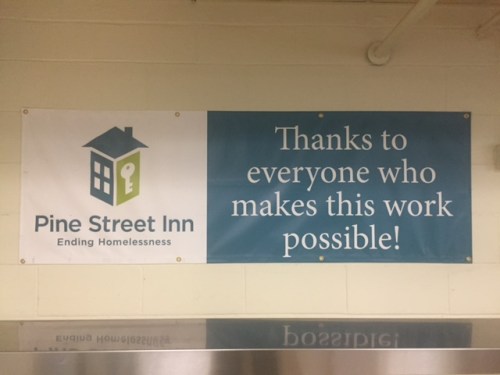
As a Bowdoin alum living in the Boston area I have enjoyed participating in the Common Good Days organized by the College. In 2016, the Bowdoin College Common Good Day in Boston was held at Pine Street Inn, a homeless shelter for men. Over the years, the College has selected different nonprofits across the country to perform a day of service. This year’s event saw almost 500 alumni, faculty, staff and friends participated in Common Good Days with various nonprofits in different cities. In Boston, there were 12 alumni and friends stationed in the Pine Street Inn kitchen to assist the staff with basic meal preparation.

img_8638

Bowdoin Alumni and Friends at 2016 Bowdoin College Common Good Day at Pine Street Inn, Boston, MA. Photo credit: Pine Street Inn Staff.

Alumni from a wide range of years, professional backgrounds and communities enthusiastically cooperated with the Pine Street Inn staff in helping to cut tomatoes, cucumbers, onions and chicken to make sandwiches for residents. Pine Street staff were generous with their time and guidance to offer a personalized tour of the facility to see how the shelter fulfills its mission. We shared stories of our Bowdoin years, previous volunteer experiences and current professional roles. Though we had never met before our common links through Bowdoin allowed us to focus on the task at hand while seeking a greater understanding of the significance of Common Good Day.

img_8635

Pine Street Inn Kitchen and Cafe. 2016 Photo credit: T. Mohammed

This marked for me a decade of participating in Common Good Days organized by the Bowdoin Club of Boston. Based on the conversations with fellow alumni at Pine Street Inn, the meaning of service varies from individual to individual. Being part of a group, working towards a common goal, helping to improve society all with a bit of fun – are some of the many reasons why people participate in such events. However, a humble suggestion for future Common Good Day planning could entail greater follow through and assessment of the impact of days of service events for long term sustainability of the organizations and individuals it aims to benefit.

Leave a comment

Filed under Capacity Buidling, Community Development, Education, Homelessness, Leadership, Networking, Philanthropy, Planning, Poverty, Psycho-Social Support, Rehabilitation, Stakeholder Engagement

Archiving Sport: How Do Libraries Connect Sport for Development and Peace?

It is really amazing how much there is to learn from being in a library. There are numerous types of libraries across the country on college campuses, in almost every neighborhood as public libraries and then the elite Presidential libraries to identify a few. The Boston Public Library in Copley Square, a newly renovated library in the heart of Boston reaches out to its community in numerous ways.

img_8617

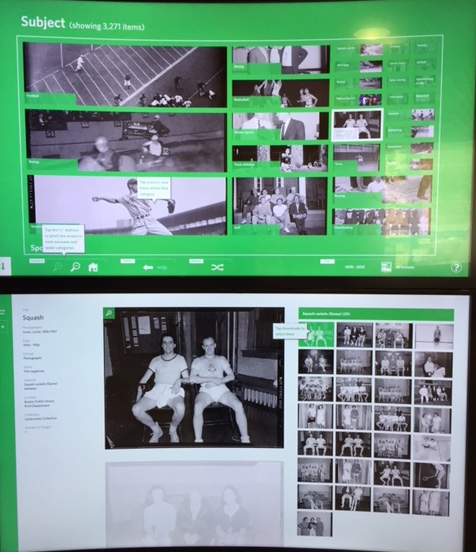
Squash Photos of Bostonions at the Boston Public Library’s Electronic Information Kiosk. Photo Credit: T.Mohammed.

On a recent visit to the newly renovated Boston Public Library in Copley Square, I came across a fascinating electronic information kiosks in the main entrance hall. At a touch screen information kiosk, there was an archive of photos of various subjects (including squash photos of Bostonians as seen above) from the City of Boston. If you click on the photo you can see the details.

This impressive kiosk with information retrieval and storage (at a cost to the taxpayers of Massachusetts) is a tremendous leap forward in understanding and connecting the sport for development and peace field to the general public. My suggestion for the many aspiring young professionals in the emerging field of sport for development and peace would be to examine the evolution of sport at your local library. You may be surprised what you find.


Leave a comment

Filed under Community Development, Education, Leadership, Literature Review, Networking, Planning, Private Public Partnerships, Professional Development, Public Policy, Squash, Stakeholder Engagement, Uncategorized

Interdisciplinary Approaches to Sustainable Coaching

On a recent trip to Blacksburg, Virginia to visit Tim Baird, Professor of Geography at Virginia Tech who is a college friend from Maine, we took a hike in Jefferson National Forest. During the hike we encountered stunning natural scenery below and shared ideas and thoughts of our respective academic pursuits. At the outset, let me state that Professor Baird’s academic performance and training has won him many awards and admiration from his students.

IMG_8537

Signpost at Jefferson National Forest Photo credit: T. Mohammed

The 2016 Rio Olympics are being broadcast worldwide so I thought I would add my bit of sporting commentary on elite amateur athletes and the rest of us. Many of the athletes have been training rigorously over 4 years or more and aim to reach peak performance during competition at the Olympics. Michael Phelps, Simone Biles or Katie Ledecky are perfect examples of athletes who are reaching peak performances at this year’s Olympics.

IMG_8538

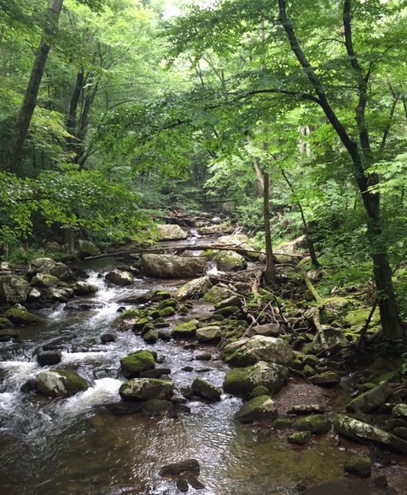
“Water in Stream” in Jefferson National Forest. Photo credit: T. Mohammed

Just like water in a stream (see photo above), my hike with Professor Baird, reminded me of my graduate school readings by Mihaly Csikzektmihalyi, a Hungarian psychologist known for his work on the concept of “flow,” in the field of positive psychology. The concept of “flow” has been applied in sport for development and peace and other disciplines.

According to Cziketmaihalyi and his 2004 TED Talk, everyone, be they an Olympian, student, coach or parent is always striving for their “A” game which means achieving a state of flow and staying in it. While Professor Baird and I are from different academic disciplines – geography and sport for development and peace  respectively- our liberal arts background allowed us to have an interdisciplinary discussion on sustainable coaching.

In Professor Baird’s case he was in the midst of publishing a new research paper on sustainable innovation which we also spoke about in depth. As for me, I am learning how to get “unstuck” and “out of my own way,” to stay in a state of flow in the field of sport for development and peace. Thanks Professor Baird for a terrific visit to Virginia and a meaningful hike!

Leave a comment

Filed under Capacity Buidling, Coaching, Education, International Development, Leisure, Literature Review, Networking, Olympic, Paralympic, Psycho-Social Support, Recreation, Rehabilitation, Uncategorized, Youth Development

Community Sport: What are Transferable Methodologies and Approaches?

The 2016 Olympics in Rio has generated terrific event in the Greater Boston area, like the one I attended yesterday with guest speakers such as Ellen Minzer, World Champion rower and award-winning coach. From her experience at elite levels of rowing and more recently as a coach to athletes with disabilities preparing for the Paralympics in Rio, Coach Minzer highlighted the importance of social inclusion in sport.

Among Coach Minzer, many coaching roles she serves as the Director of Outreach with Community Rowing Inc a sport-based youth development program based in Boston. In listening to Coach Minzer presentation, I began to see linkages in the aspirations of what Kidsquash was striving for in Boston and Khelshala in India. Comparisons can be made in community sport – such as rowing and squash – though executed differently by athletes during competition.

logo

Squash is mostly an individual sport in that during competition on the court it is one versus one, although there are team events too such as doubles squash with two versus two. Rowing is more of a team sport although there can be events with single sculling. The question for program directors of sport-based youth development programs from different community sports becomes what best practice in coaching rowing can be applied to squash or vice versa? What coaching methodologies do coaches use with differently aged and abled athletes? What coaching philosophies or approaches can program directors help to implement?

athletic-coaching-banner

These questions have societal consequences for all stakeholders in sport and beyond. This is why it is important to create more qualified coaches such as Coach Minzer who gives back to the sport, no matter what the level of the athletes, as they can help raise standards in community sport practice and participation. The Institute of Athletic Coach Education at Boston University is a fantastic resource for program directors and coaches to begin or enhance their professional development with sport-based youth development programs.

Leave a comment

Filed under Capacity Buidling, Coaching, Community Development, Conferences, Education, Gender, Leadership, Leisure, Networking, Paralympic, Professional Development, Rehabilitation, Stakeholder Engagement, Youth Development

Enriching High-Ability Middle School Students in Sustainable Development

This spring, I’ve been teaching part-time at Acera: The Massachusetts School of Science, Creativity and Leadership: Science, Technology, Engineering, Arts and Mathematics (STEAM) Enrichment Program focusing on current events, political activism and global issues for high-ability middle school students to help them become the best version of themselves.

As the Political-Science / Model United Nations Club Leader I co-facilitated simulations and discussions related to international sustainable development and the U.S. Presidential Elections. We started with global issues and then domestic political issues. The Acera middle school students are highly intelligent, passionate and creative leading to animated discussions which were engaging, lively and heartfelt.

Poli Sci - Model UN students from Acera School attending the 2016 Massachusetts Democratic Convention in Lowell, MA.

Political Science – Model UN students from Acera School attending the 2016 Massachusetts Democratic Convention in Lowell, MA. Photo Credit: T. Mohammed

As part of the course design, I initiated a Field Trip for 2 boys to the 2016 Massachusetts Democratic Convention at the University of Massachusetts at Lowell’s Tsongas Arena. This was a unique opportunity for Jakob, Jamie and myself to listen and observe to the leadership of the Massachusetts Democratic Party establishment. After checking in at the registration desk, we made our way into the Tsongas Arena Indoor stadium where we able to get a close view of the many speakers such as Elizabeth Warren, Maura Healey, Marty Walsh, Ed Markey to name a few.

While sitting in the 5th Middlesex District seating session we had an opportunity to ask Sue Thompson, a Massachusetts delegate about the nature of the 2016 convention, the role of delegates and super delegates and how young people can get more involved in the Massachusetts Democratic Party through its youth wing. In addition, as attendees we were able to collect brochures, literature, pins, posters and bags to further raise awareness of the candidates and issues which Massachusetts Democrats seek to address and take action on 2016 and beyond.

Overall, it was my pleasure to facilitate the teaching and learning for a group of cooperative and coachable middle students who were keen to learn more about active citizenship. Thank you Acera students, staff and parents for the opportunity!

Leave a comment

Filed under Capacity Buidling, Coaching, Community Development, Education, Leadership, Networking, Volunteering, Youth Development

Striving for Meditation and Mindfulness On and Off the Court

I recently traveled to the beautiful state of Oregon for a family vacation. It was my first visit to Oregon and home state of the world headquarters of Nike. I did inquire with my Uber driver about the possibility of doing a tour of the Nike campus but it was closed for the weekend.

However, my parents and I visited the Portland Japanese Garden which was a great reminder of the art of practicing mindfulness and meditation. The stones, waterfalls and fauna all created a sense of calm that Jon Kabat Zinn once spoke about during a lecture I attended in Boston’s Arlington Street Church.

Portland Japanese Garden

Visit to Portland Japanese Garden Photo Credit: T.Mohammed

Mindfulness and meditation are methods of coaching that are very much in the news and being written about by academics, medical professionals and sport researchers. Amy Baltzell recently published a book with several authors on Mindfulness and Performance and Sam Parfitt leads the True Athlete Project which both reinforce the sporting applications for mindfulness and meditation. The science behind meditation and mindfulness is helping with the evolution of sport for development and peace as a form of daily practice to aspire towards.

Leave a comment

Filed under Coaching, Education, Leisure, Literature Review, Networking, Psycho-Social Support, Recreation, Rehabilitation