Category Archives: Capacity Buidling

Collaborating, Learning and Adapting (CLA) in Sport for Development and Peace

Thanks to colleagues, Erika Mueller (Peace Corps),  Mori Taheripour, (The Wharton School, University of Pennsylvania), Eli Wolff (Brown University) and Sarah Hillyer (University of Tennessee) in the International Sport for Development and Peace Association (IDSPA) for the invitation to participate in the Sport for Development M&E Virtual Roundtable Series.

A concise, thorough and inspiring presentation, entitled “More Than A Game: Using Soccer to Create a Level Playing Field for Girls” was be led by Ben Sanders, Director of Programmes, Grassroot Soccer South Africa. Grassroot Soccer is an adolescent health organization that leverages the power of soccer to educate, inspire, and mobilize youth in developing countries to overcome their greatest health challenges, live healthier, more productive lives, and be agents for change in their communities. 

The USAID Sport for Development M&E Learning Lab is a platform that allows USAID Missions, NGOs, academics, corporate partners and donors to identify and examine evaluation outcomes of programs that use sport to achieve development goals. Group members use this platform to share knowledge, identify best practices, and disseminate research outcomes. Through open information exchange and collaboration, the platform allows members to support the advancement of sport for development and peace programs globally.

Mr. Sanders and his colleagues also referenced a report and digital storytelling to share best practices and lessons learned from Grassroots Soccer. Both are highly recommended for additional reading and viewing. Overall, participating in the seminar was a cost-effective method of keeping up with one of the leading sport for development organizations in the world. Khelshala and others NGOs have a lot to learn from Grassroot Soccer.
Leave a comment

Filed under Capacity Buidling, Coaching, Community Development, Education, Gender, HIV AIDS, International Development, Leadership, Literature Review, Networking, Planning, Poverty, Private Public Partnerships, Professional Development, Stakeholder Engagement, Youth Development, Youth Sport

Comedy Sportz: Improvising Your Game While Laughing

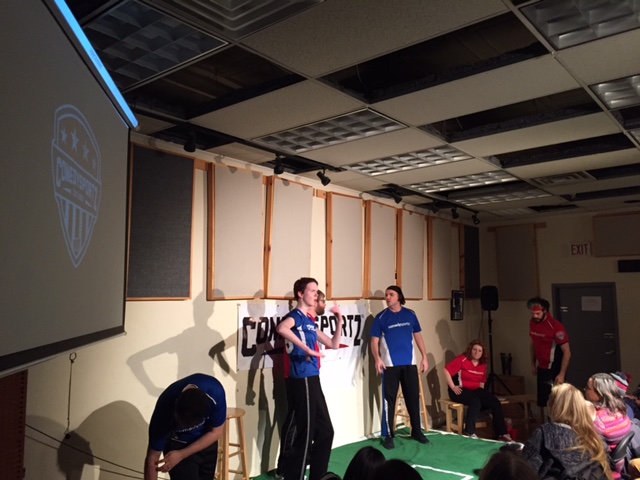
Recently on a Friday evening, I visited the Riot Theater in Jamaica Plain, Boston, Massachusetts where I was fortunate to watch Comedy Sportz for my first time who are a fantastic group of improvisational actors. Without out really knowing much about the group or the content show I was blown away by their creative spin on blending creativity, dynamism and humor.

Comedy Sportz actors in The Zone at the Riot Theater. Photo credit. T. Mohammed, 2017.

Comedy Sportz actors in The Zone at the Riot Theater. Photo credit. T. Mohammed, 2017.

The Riot Theater is the Comedy Sportz, first location in the Greater Boston area. Being someone who has observed a fair amount of sports coaching, I was really struck by the actors energy, wit and participatory audience. In many ways coaching and teaching is like acting and so it was interesting to observe how others perform and what they can do better than some experienced but less theatrical coaches or teachers.

Courtney Pong, the Referee (GM and Owner) of Comedy Sportz,Boston leading the show.

Courtney Pong, the Referee (GM and Owner) of Comedy Sportz,Boston leading the show.

The way the show is structured has a sports element to it with a red team and a blue team with one referee plus scoreboard. Just like a sporting contest they are all in uniforms and are guided by the referee to play certain type of improvisational games. Audience participation is encouraged who are upwards of 7 years old. It is a great family atmosphere with candy for kids too! I hadn’t laughed in a long time and left in stitches. No pun intended.

Leave a comment

Filed under Capacity Buidling, Coaching, Community Development, Education, Gender, Leisure, Networking, Professional Development, Psycho-Social Support, Recreation, Stakeholder Engagement

2017 Emmaus Martin Luther King Day of Service

Bowdoin squash alum introduced me to VolunteerMatch, a wonderful website that connects nonprofit organizations with volunteers. Hence, in an effort to continue volunteering locally I was matched with Emmaus Inc, a Haverhill, Massachusetts-based nonprofit organization that addresses homelessness through empowerment. How did this happen?

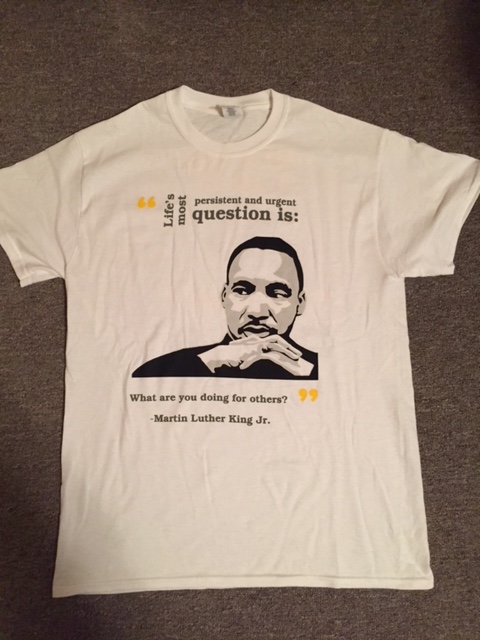
T-shirt for Emmaus Volunteers, special event for 2017 MLK Day of Service.

Emmaus Volunteers received the T-shirt above for its 4th Annual 2017 Martin Luther King Day of Service.

The process to act upon my volunteer interest was to register with VolunteerMatch, express interest in organizations and causes near my zip code and then select volunteer opportunities based on mutual interest and availability. My first onsite meeting with Emmaus’s Empowerment Project Coordinator facilitated registration, identification verification and completing background (CORI) checks. I was then emailed by the coordinator the general volunteer responsibilities.

As a Family Guide, my volunteer role for the 2017 Emmaus Martin Luther King Day MLK Day was to provide a welcoming atmosphere for disadvantaged families and individuals at the Resource Fair and Family Theater  Almost 200 people from the Haverhill community attended the event and Emmaus Inc had over 130 volunteers respond to the call to work on various MLK day projects. Each volunteer received a free T-shirt, as seen above. For more information, check out pictures from the event on the Emmaus Inc. social media pages! Thank you to VolunteerMatch for helping me to make the Emmaus event a success.

If you are looking for ways to give back to your local community, connect with like-minded individuals and organizations as well as ease your way your back to full-time paid employment, VolunteerMatch, might be a useful tool to make your next steps in the new year.

Leave a comment

Filed under Capacity Buidling, Community Development, Education, Homelessness, Networking, Peace Building, Philanthropy, Poverty, Stakeholder Engagement, Volunteering

Coaching Up!: A Coaching Methodology for Multiple Contexts

It is not very often that someone you have never met from the coaching profession sends you a thank you gift in the mail. What made it special was that it was a thank you gift from, Jordan Fliegel a fellow Bowdoin alumnus, who has combined his passions for leadership, sport and business to create a profitable enterprise called CoachUp. Based on my knowledge of the coaching landscape in the United States, CoachUp is the only for-profit enterprise that addresses the market gaps in multiple sports through private coaching.

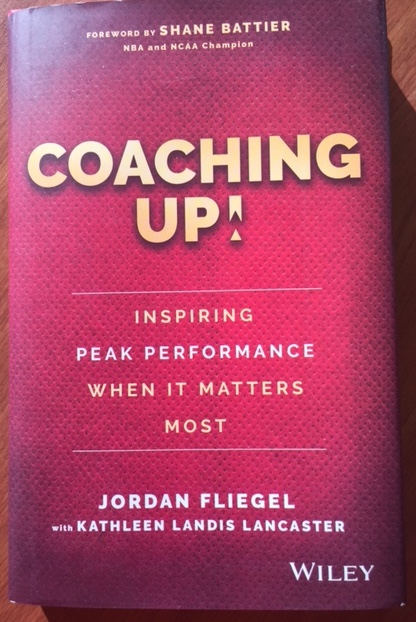
Thank You Gift from CoachUp. Photo credit: T.Mohammed, 2017.

Thank You Gift from CoachUp. Photo credit: T.Mohammed, 2017.

Jordan’s accomplishments in the classroom, on the court and now in the business of sport are no doubt impressive. His latest book titled “Coaching Up: Inspiring Peak Performance When it Matters Most,” gives readers a clear sense of Jordan’s model for coaching in both sport and non-sport settings. The coaching methodology he espouses enables coaches to build authentic connections, give genuine support and communicate concise directions. If I were a student or practitioner in coaching, looking to gain new approaches and methodologies then, this easy-to-read book would be worthy of your time.

Furthermore, if you are a coach, parent or volunteer looking to provide or procure private coaching to athletes of all ages, then consider booking an appointment with a CoachUp provider. The CoachUp platform is intuitive, secure and safe. All the CoachUp coaches have background checks and have access to insurance for greater customer satisfaction. Thanks Jordan and the rest of the CoachUp team for a copy of your latest publication and enabling private coaches and athletes to seek better results in sport and life.

Leave a comment

Filed under Capacity Buidling, Coaching, Community Development, Education, Leadership, Literature Review, Professional Development, Youth Development, Youth Sport

Mind, Body, Game Connection: How it Works for Everyone

I played American collegiate squash for a Division 3 NCAA varsity team. In the larger sports universe, I would be considered an average amateur athlete. I was encouraged by my coaches and enjoyed participating in a variety of sports then onto coaching student athletes at the community, high school and collegiate levels and remaining physically active thereafter. During the winter season, most of us take time to slow down, reflect and recharge for the next calendar year.

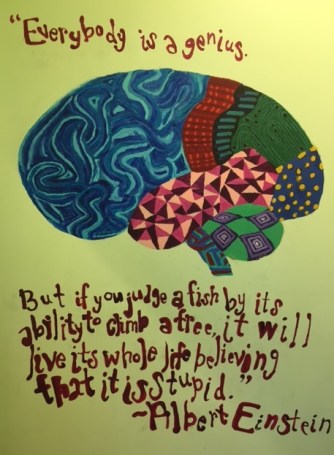
During my mini-teaching assignment at the Acera School: The Massachusetts School of Science, Creativity and Leadership, I was lucky to be surrounded and challenged by high-ability middle schoolers. While learning about the school, its students, and their aspirations, I came across the mural below, that caught my attention. It may me ponder.

img_8316

Albert Einstein Quote in classroom at Acera School: The Massachusetts School for Science, Creativity and Leadership. Photo credit: T.Mohammed, 2016.

The Founders of Acera and Khelshala share similar struggles in that they aimed to create new and innovative educational institutions (in different settings – high-income and low-income settings respectively) with students whose thirst for knowledge and learning was on par with one another. The Acera students are more articulate advocates in global and current issues than the Khelshala students are, but that did not make Khelshala students any less studious, curious or analytical than their American counterparts.

Most trained teachers and coaches are familiar with the Bell-curve which they use for grading and evaluating students. This applies in sport where one has elite student-athletes at the Division 1 NCAA level and the more academically “balanced” students at the Division 3 NCAA level.

To think that “everyone is a genius” goes against the notion of the Bell Curve, but reaffirms the idea that “coaching happens in a context,” as Professor John McCarthy of Boston University’s Institute for Athletic Coach Education always reminds his students. Closing the student achievement gap between Khelshala students and Acera students comes down to giving the Khelshala students as many learning and enrichment opportunities to succeed and thrive.

Not all students will become the next Albert Einstein or Jansher Khan, but that’s okay. Students have it within themselves to tap their “inner” genius to their learning and life obstacles. Sadly, not all learning happens at the same rate and some students will be slower and perhaps left behind. This is where greater resources and support are necessary. Regardless, teachers light the fire in their students, at all ages and stages.

Leave a comment

Filed under Capacity Buidling, Coaching, Education, Leadership, Literature Review, Professional Development, Squash, Youth Development

Concerts for Sport for Development and Peace?

A few years ago I blogged about what the field of sports for development and peace can learn from the arts? Music is often considered a great communication tool to bring people together. There have been many types of benefit concerts during my lifetime. The LiveAid, Farm Aid and Live 8 concerts are some of the larger benefit concerts that have happened across the globe. Patrick Kabanda, a friend at the Office of the Chief Economist at the World Bank, has written extensively about the importance of the arts to economic and social development. His publications offer great insights.

1470846201826

I recently attended a Lampedusa, a Concert for Refugees in Boston at the Berklee College of Music. It was a sold out show with humorous dialogue and well crafted songs by all the musicians. Clearly, such an event is a win-win situation for the musicians, fans, sponsors and aid recipients. Small scale concerts may be just as good as large scale events in that they can draw loyal fans and supporters. Professional athletes and musicians are often grouped together in the entertainment business which may lead to ease of working together. Personally, the Lampedusa tour stop in Boston, happened to be on my birthday which made it all the more special and memorable.

As a member of the International Sport for Development and Peace Association (ISDPA), I would urge my colleagues in the field to explore ways in which benefit concerts can be used as a fundraising tool to benefit disadvantaged athletes. Choosing which non-governmental organization to benefit from the concerts could be done based on pooling of resources. For example ISDPA, could collect the funds and make equal distributions to its member organizations. In the United States, Up2Us, a sport-based youth development coalition would be a good starting point. An event organizer, may ask is there a demand for such a concert to benefit disadvantaged athletes? My answer would be, just ask around and you never know if there are a group of musicians passionate about similar issues.

Leave a comment

Filed under Capacity Buidling, International Development, Leadership, Leisure, Networking, Peace Building, Philanthropy, Poverty, Private Public Partnerships, Youth Development, Youth Sport

What are Indicators of Youth Development?

Thanks to big data and increasingly shared datasets, the concept of youth development is being qualitatively measured across countries. The Commonwealth Secretariat recently released its third “Global Youth Development Index and Report” to measure how young people in 183 countries are positioned for the future.

Artistic Interpretation of Youth Development.

Source: Artistic interpretation of Youth Development in Key West, Florida. Photo Credit: T. Mohammed, 2015.

The report uses 5 domains which the authors see as critical to youth development: education, health, employment civic participation and political participation. My previous post gave examples of social entrepreneurs and policy makers working to achieve the United Nations’ Sustainable Development Goals. This report acts as an impressive data-advocacy tool to focus attention and investment where needed the most.

The Commonwealth Secretariat’s Global Youth Development Index (GYDI) allows the public to compare and contrast countries where youth development is going well and not so well. Based on the GYDI, what attention and investment can you or your organization make in youth development?


Leave a comment

Filed under Capacity Buidling, Education, Foreign Policy, Grant Making, International Development, Leadership, Literature Review, Philanthropy, Planning, Private Public Partnerships, Public Policy, Stakeholder Engagement, Youth Development

India, Uganda and USA: What Can We Learn by Comparing and Contrasting in Youth Development?

As mentioned, in earlier blog posts thanks to my formative United Nations Volunteer experience in Uganda, I’ve spent considerable time and energy as a founding team member of Khelshala in India. In the last couple of weeks, I was fortunate to attend fundraisers at Khelshala in Boston and the The Child Is Innocent in Boston. For both of these non-governmental organizations, this was my second time attending their fundraisers.

Listening to Satinder Bajwa (an engineer by training, turned coach and teacher) and Kevin Schwartz (a pediatric oncologist), as co-founders of their respective non-governmental organizations, I was reminded by other inspirational leaders I’ve heard speak at the Harvard Kennedy School in the social enterprise movement such as Mohammed Yunus of Grameen Bank or Bill Drayton of Ashoka, who have used their talents to improve the lives of the next generation of leaders. The objectives and challenges facing both Khelshala and The Child is Innocent are simultaneously similar and different.

Today, perhaps more than ever, it is possible for young people to make a difference through grassroots activism, social justice campaigning and demonstrating solidarity with those who are disenfranchised. Small steps taken over a long horizon can and do make a difference for organizations like Khelshala and The Child Is Innocent. How and when will you make your next step?

Leave a comment

Filed under Capacity Buidling, Community Development, Education, Grant Making, International Development, Leadership, Networking, Philanthropy, Poverty, Professional Development, Public Policy, Stakeholder Engagement, Uncategorized

What does Peace Look Like?

The 2016 Positive Peace Report by the Institute of Economics and Peace, helps non-experts understand what peace looks like from a macro perspective. I found the diagram below from the report to be a very noteworthy depiction of what the positive elements of peace look like for a nation. I shall not repeat the content of the report, but would like to elaborate on a couple of contemporary issues.

peace

Source: 2016 Positive Peace Report by Institute of Economics and Peace.

The humanitarian crisis in Syria according to Ban Ki-Moon, Secretary General of the United Nations is “appauling,” with the thousands of deaths, especially young children. The Secretary General and the international community are taking steps for a peaceful solution to the conflict using diplomatic tools and maneuvers for a constructive dialogue that intends to put an end to the violence. However, many innocent Syrians and peacekeepers are being caught in the middle of the violence.

Approximately 5 years ago, I had the honor and privilege of attending a retreat with Thich Nhat Hanh, a Buddhist monk who has authored many self-help books on health and wellness. Perhaps the Syrian government and its people would benefit from listening, reading and learning from Thich Nhat Hanh’s teachings. When a cease-fire is reached by the Syrians themselves, they may wish to look at themselves in the mirror and make peace with themselves. In my humble opinion, by rejecting violence, it is easier to accept peace.


Leave a comment

Filed under Capacity Buidling, Community Development, Conflict Resolution, Education, Foreign Policy, Leadership, Literature Review, Peace Building, Public Policy, Stakeholder Engagement, Uncategorized

Celebrating a Decade of Common Good Days

As a Bowdoin alum living in the Boston area I have enjoyed participating in the Common Good Days organized by the College. In 2016, the Bowdoin College Common Good Day in Boston was held at Pine Street Inn, a homeless shelter for men. Over the years, the College has selected different nonprofits across the country to perform a day of service. This year’s event saw almost 500 alumni, faculty, staff and friends participated in Common Good Days with various nonprofits in different cities. In Boston, there were 12 alumni and friends stationed in the Pine Street Inn kitchen to assist the staff with basic meal preparation.

img_8638

Bowdoin Alumni and Friends at 2016 Bowdoin College Common Good Day at Pine Street Inn, Boston, MA. Photo credit: Pine Street Inn Staff.

Alumni from a wide range of years, professional backgrounds and communities enthusiastically cooperated with the Pine Street Inn staff in helping to cut tomatoes, cucumbers, onions and chicken to make sandwiches for residents. Pine Street staff were generous with their time and guidance to offer a personalized tour of the facility to see how the shelter fulfills its mission. We shared stories of our Bowdoin years, previous volunteer experiences and current professional roles. Though we had never met before our common links through Bowdoin allowed us to focus on the task at hand while seeking a greater understanding of the significance of Common Good Day.

img_8635

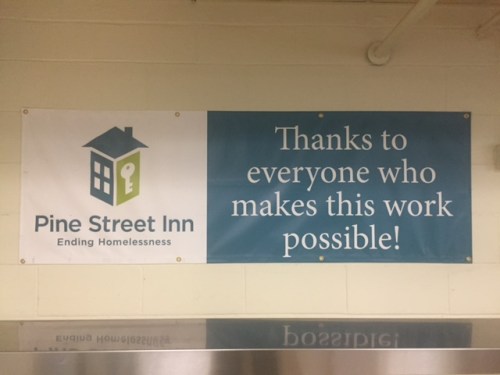
Pine Street Inn Kitchen and Cafe. 2016 Photo credit: T. Mohammed

This marked for me a decade of participating in Common Good Days organized by the Bowdoin Club of Boston. Based on the conversations with fellow alumni at Pine Street Inn, the meaning of service varies from individual to individual. Being part of a group, working towards a common goal, helping to improve society all with a bit of fun – are some of the many reasons why people participate in such events. However, a humble suggestion for future Common Good Day planning could entail greater follow through and assessment of the impact of days of service events for long term sustainability of the organizations and individuals it aims to benefit.

Leave a comment

Filed under Capacity Buidling, Community Development, Education, Homelessness, Leadership, Networking, Philanthropy, Planning, Poverty, Psycho-Social Support, Rehabilitation, Stakeholder Engagement